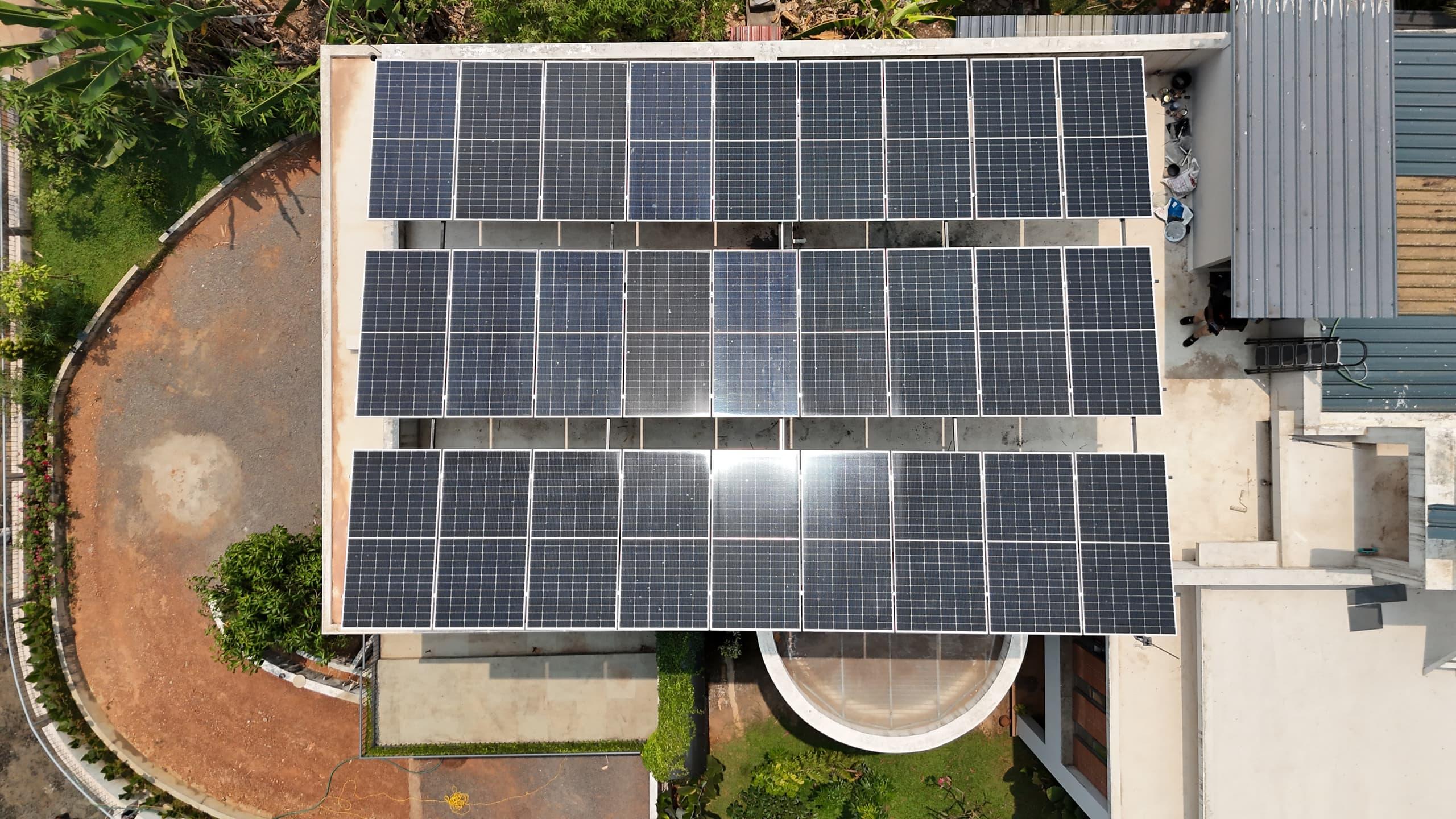

PM Surya Ghar 2026: loan, EMI and the full process
2026
This is the central rooftop solar subsidy, explained the way we actually execute it for Kerala homeowners: how much you can claim at each system size, who qualifies, what solar really costs here, the documents you need, where KSEB comes into it, and when the money reaches your bank account.
The slabs
Last reviewed . Amounts and eligibility are decided by the scheme; confirm on the national portal before you commit money.
₹30,000 per kilowatt for the first two kilowatts, ₹18,000 for the third, and nothing beyond that. Which means 1 kW earns ₹30,000, 2 kW earns ₹60,000, and everything from 3 kW upward earns ₹78,000. Move between the sizes below and watch where it stops.
Choose your system size
Central subsidy · PM Surya Ghar
Indicative central subsidy
₹78,000
At the ₹78,000 ceiling
The most common Kerala home system, and where the subsidy maxes out.
What you would actually pay
Indicative Kerala market range, not a SEDNA quotation. Real pricing depends on your roof, structure, cable runs, panel and inverter choice, and any electrical work your board needs. The subsidy is paid to you after commissioning, so you fund the full amount first.
Why the subsidy stops growing at 3 kW
The blue bar is flat from 3 kW onward. That is the whole point: ₹78,000 is a ceiling, not a rate. A 5 kW system receives exactly what a 3 kW system receives, so every kilowatt past the third is paid at full price. Size the system for your bill, not for the subsidy.
Your eligibility and final CFA are decided by the scheme, not by us.
The scheme is deliberately narrow. It is for ordinary homes on ordinary domestic connections, connected to the grid and metered. Almost every rejection we see comes from one of these conditions, not from bad luck.
The CFA is for residential consumers. Businesses are not left out of solar, they are simply funded differently, usually through accelerated depreciation and the tax route.
A system with no grid connection and no net meter cannot be inspected or commissioned by KSEB against the scheme, so it cannot draw the CFA.
Schools, trusts, places of worship and government offices fall under other MNRE programmes, not the residential CFA.
The CFA is once per eligible connection. If a previous owner claimed it on that consumer number, a second claim will not pass.
A flat owner with an individual KSEB domestic connection and rights to roof or terrace space can apply on their own, on the normal residential slabs.
For shared load, lifts, corridor lights, pumps and common EV charging, a Group Housing Society or Resident Welfare Association can claim ₹18,000 per kW, up to 500 kW. That ceiling is worked out at 3 kW per house and it counts any individual rooftop systems residents have already installed.
Under the KSERC 2025 regulations, net metering for the common service connection of a multi-storeyed domestic apartment is allowed up to 500 kW, which is what makes the society route practical in Kerala.
We will not put a price list on a web page and call it a quotation. What we can give you honestly is the shape of the market, what moves a price up or down, and the fact that you pay the full amount first and receive the subsidy afterwards.
Two quotes for the same kilowatts can differ by a third, and usually it is not margin. It is these:
This trips people up more than the amount does. Plan your cash flow around it.
You pay the full project cost
To your installer, on the agreed schedule, before any subsidy exists.
KSEB commissions the system
Inspection, net meter, and the commissioning certificate uploaded to the portal.
The CFA is transferred to you
By DBT, into your own bank account. Officially within 30 days of that upload.
So the subsidy is a reimbursement, not a discount at the till. Anyone presenting it as an instant price cut is either confused or collecting your money. For indicative numbers by system size, use the explorer above, then read how to compare two solar quotes.
Rather not pay it all up front?Bank loans over 3 to 10 years, with the subsidy still credited to you.From the application to money in the bank. The roof work is the short part; the approvals are what set the calendar. You can check your own status at every stage on the national portal, whoever installs for you.
You, with us beside you
The application goes in at pmsuryaghar.gov.in against your KSEB consumer number and your mobile. You pick the capacity your roof and your bill justify, not the capacity that maximises a subsidy slab. The login stays yours, so you can check the status at any stage without asking anyone.
KSEB (your DISCOM)
KSEB checks your connection, your sanctioned load and whether the local transformer and line can take the export, then issues feasibility approval. The regulations provide for this study to be completed within 15 days of a complete online application. Nothing should be installed before this arrives.
Your installer
The scheme requires a vendor registered on the national portal and DCR modules from the ALMM list. For a typical home system the physical work is short: mounting structure, modules, inverter, cabling, earthing and surge protection. The paperwork around it takes longer than the roof work.
KSEB
A KSEB engineer inspects the plant against the sanctioned application, confirms the installed capacity matches, then the bidirectional net meter is fitted and the system is commissioned to the grid. Meter availability at the section office is the most common delay in Kerala, not the inspection itself.
You and KSEB
You submit your bank account details and a cancelled cheque on the portal. KSEB uploads the commissioning certificate, which is the step that actually starts the subsidy clock. Until that certificate is up, nothing is moving, whatever anyone tells you.
MNRE, direct to you
The subsidy is released by Direct Benefit Transfer into the account you registered. The official benchmark is within 30 days of the commissioning report being uploaded. Real-world timelines vary by state and by queue, so treat 30 days as the standard being worked to, not a promise.
The homeowner
Your DISCOM
A portal-registered vendor
Nothing exotic. Almost everything is already in the house. The one that catches people out is the name on the electricity bill, which has to match the applicant and the bank account.
Portal requirements are updated from time to time, and what is asked for can differ slightly between applications. Treat this as the working checklist, and check the current instructions on the PM Surya Ghar portal before you submit. If you are applying with us, we go through this list with you before anything is filed.
People search for a KSEB solar subsidy, find a page about a scheme that is no longer the one paying, and plan around the wrong number. Here is the clean version.
Central Government · MNRE
The scheme that actually pays the subsidy. It sets the ₹30,000 / ₹60,000 / ₹78,000 slabs, runs the national portal, and transfers the CFA to your bank account directly.
Kerala's DISCOM
Your electricity utility, and the hands-on party. Feasibility approval, inspection, the bidirectional net meter, commissioning, and uploading the certificate that releases your money.
State Implementation Agency
Kerala's nodal renewable energy agency, coordinating the scheme in the state alongside KSEB. You will not usually deal with ANERT directly as a homeowner.
Older / separate scheme · not the current CFA
These were earlier Kerala rooftop programmes with a percentage-based subsidy, usually quoted as 40 percent up to 3 kW and 20 percent beyond. That structure is not what pays today, and a good deal of what still ranks for “KSEB solar subsidy” describes it as if it were current. If a page quotes you a percentage of a benchmark price, or a deadline in 2024, you are reading about the old scheme. The residential subsidy today is the central PM Surya Ghar CFA: a fixed ₹30,000, ₹60,000 or ₹78,000.
Your roof generates most in the middle of the day, when the house is usually at its quietest. Rather than waste that, a bidirectional meter counts both directions: units you export to KSEB, and units you draw back at night.
You are billed on the net difference. Surplus is banked and carried forward, and whatever is left at the annual settlement is compensated by KSEB at the rate the regulator fixes.
It also matters for the subsidy: the CFA is for grid-connected rooftop solar, and net metering is how that connection is measured and commissioned. No net meter, no commissioning, no money. Longer explainer here.
KSERC notified the Renewable Energy and Related Matters Regulations, 2025. They came into force on 6 November 2025, and the new billing arrangements applied from 1 January 2026.
Worth knowing: the draft version of these regulations proposed much tighter limits, and a lot of published advice still repeats the draft as though it were law. The notified rules are more generous. Confirm the current position for your own connection with KSEB before you fix a system size.
Every one of these is something we have been called in to fix after the fact. None of them are hard to catch at the quotation stage, if you know the sentence to listen for.
Red flag 01
The CFA is paid by DBT into the applicant's own bank account. It never reaches the installer. Any arrangement where the company collects it is a company taking money that was meant for you.
Red flag 02
It does not. The central CFA is capped at ₹78,000 for anything 3 kW and above. A quote built on a larger subsidy figure is a quote that will come up short.
Red flag 03
Not before KSEB's feasibility approval. Installing early puts your eligibility at risk. If a team is free tomorrow, the team can wait for the approval.
Red flag 04
There is no private processing fee for the CFA. Applying on the national portal is free. Nobody can guarantee an amount before feasibility and inspection.
Red flag 05
Only India-made DCR modules on the ALMM list qualify. Imported or unlisted modules may be perfectly good panels and still fail the claim. Ask for the exact model and check it on the ALMM list before you sign.
Red flag 06
They do not. The residential CFA is for domestic connections. A vendor who does not know this is telling you something about the rest of their paperwork.
The simplest protection is that the application is yours. You hold the portal login, the bank account is in your name, and you can check the status at any stage without asking your installer for permission. If a company is reluctant about any part of that arrangement, you have learned what you needed to know. More on the patterns we see.
Nothing on this page requires an installer to unlock. The portal is public, the slabs are fixed, and the money comes to you either way. What we add is that we have walked the queue enough times to know where it stalls, and we chase the file rather than waiting for it.
Roof and shadow survey
Measured on site, through the day, free.
Honest system sizing
Against your real bill, not the subsidy slab.
Portal application support
Filed and tracked with you, in your login.
ALMM-listed DCR modules
The exact model named in the quotation.
Installation
Structure, wiring, earthing and surge protection.
KSEB coordination
Feasibility, inspection, net meter, commissioning.
Certificate follow-through
The upload that actually releases your CFA.
Service afterwards
The part most companies stop doing in year three.
We install and service across all fourteen districts from our workshop in Cherthala, Alappuzha, with most of our work concentrated in Alappuzha, Ernakulam, Kottayam and Thrissur. See recent installations.
“Before solar our bill was between ₹2,000 and ₹3,000. Now it comes between ₹125 and ₹150, and we received the ₹78,000 subsidy. They worked well, without damaging anything, and finished quickly.”
“We went to Canara Bank, they gave us clear information on the subsidy, we filled in the application and the subsidy came to our account. Our bill was up to ₹2,000 a month; now it is around ₹200 to ₹300.”
“When the PM Surya Ghar scheme came, I applied and things moved quickly. SEDNA is near my home and I know them, so I gave them the project.”
2026
DCR panels use cells made in India and cost a little more; only DCR-certified panels qualify for the central subsidy.
2026
The feasibility fee, the grid registration fee and the part of it that is refunded after commissioning.
2025
2025
There is one subsidy for homes in Kerala today: the central PM Surya Ghar Central Financial Assistance. It is ₹30,000 for 1 kW, ₹60,000 for 2 kW, and ₹78,000 for 3 kW and above. Kerala does not currently add a separate state top-up on residential rooftop solar, so the central CFA is the number that matters.
₹30,000. The scheme pays ₹30,000 per kW for the first two kilowatts, so 1 kW earns the full ₹30,000, assuming your application and installation meet the scheme conditions.
₹60,000, which is ₹30,000 per kW for both kilowatts. This is the last size where the subsidy still scales in a straight line.
₹78,000. The third kilowatt is paid at ₹18,000 rather than ₹30,000, so 3 kW works out to ₹30,000 plus ₹30,000 plus ₹18,000. This is the maximum residential CFA, and 3 kW is the most common home system in Kerala.
No. ₹78,000 is a ceiling, not a rate. A 5 kW system and a 10 kW system both receive ₹78,000, exactly the same as a 3 kW system. Larger systems can still be the right choice when your consumption justifies them, but the subsidy stops growing after 3 kW, so everything above that is paid at full cost.
A residential KSEB consumer with a live domestic connection, a usable shade-free roof, a grid-connected system with net metering, an installer registered on the national portal, ALMM-listed DCR panels, and a bank account in the applicant's name. The connection must also not have claimed the central subsidy before.
Yes, in two ways. A flat owner with their own domestic connection and rights to roof space can apply on the normal residential slabs. Separately, a Group Housing Society or Resident Welfare Association can claim ₹18,000 per kW for common facilities such as lifts, corridor lighting, pumps and EV charging, up to 500 kW, calculated at 3 kW per house and inclusive of any individual systems residents already have.
No. The CFA is for residential consumers. Commercial and industrial solar is still very much worth doing in Kerala, but it is funded through accelerated depreciation and the tax route rather than through this scheme. Anyone promising you ₹78,000 on a commercial connection has the scheme wrong.
The CFA is for grid-connected rooftop solar with net metering, because KSEB has to inspect and commission the system against the grid for the claim to complete. A pure off-grid system does not qualify. A hybrid system with batteries can qualify where it is genuinely grid-connected and net metered, but confirm the configuration with your installer and KSEB before you order anything.
Register at pmsuryaghar.gov.in with your KSEB consumer number and mobile, submit the application, wait for KSEB's feasibility approval, install through a portal-registered vendor, have KSEB inspect and fit the net meter, then submit your bank details. The CFA is transferred to you directly once the commissioning certificate is uploaded.
Your KSEB consumer number and a recent bill, Aadhaar with a linked mobile, and bank account details with a cancelled cheque or passbook copy. PAN is asked for during bank verification. If the bill is not in your name you will need proof of your right to the roof, and sometimes a name-correction affidavit. Portal requirements do change, so check the current instructions before you submit.
Yes. The scheme runs through your DISCOM, which in Kerala is KSEB, and the whole application is keyed to your consumer number. KSEB does the feasibility approval, the inspection, the net meter and the commissioning. Without a live KSEB domestic connection there is no application to make.
Yes, and you should. The only hard condition is that the vendor is registered on the PM Surya Ghar national portal. Beyond that, choose on survey quality, the exact panel and inverter models quoted, and whether the company will still answer the phone in year six.
No, and this is the most expensive mistake in the scheme. The application and KSEB's feasibility approval must come before installation. A system built first can be refused, and there is no appeal that gives you the money back. If an installer suggests starting now and sorting the paperwork later, stop there.
A bidirectional meter records both what you draw from KSEB and what your roof exports back. You are billed on the net difference, so daytime generation offsets night-time consumption instead of being wasted. It is also a scheme requirement: the subsidy is for grid-connected solar, and net metering is how that connection is measured.
KSERC notified the Renewable Energy and Related Matters Regulations, 2025. They came into force on 6 November 2025 and the new billing arrangements applied from 1 January 2026. The final regulations allow domestic net metering up to 20 kW, which is far more generous than the 3 kW cap proposed in the draft that was widely reported in 2025. Grid support charges apply only above 10 kW. Because the draft and the final rules differ, check the current position with KSEB before you fix your system size.
No, and this causes a lot of confusion. Soura was KSEB's own earlier rooftop programme, and ANERT ran a separate state scheme called Surya Thejus. Those older schemes used a percentage-based subsidy, typically quoted as 40 percent up to 3 kW. That structure is not the current one. Today the residential subsidy is the central PM Surya Ghar CFA of ₹30,000, ₹60,000 or ₹78,000. If a page quotes you 40 percent of a benchmark price, you are reading old information.
The clock starts when KSEB uploads the commissioning certificate, not when you apply and not when the panels go up. From that point the official benchmark is release within 30 days by Direct Benefit Transfer. In practice it varies by state and by queue. We would rather tell you it is typically a few weeks to a few months than promise a date the scheme does not promise us.
It should not. You pay the full project cost to the installer, and the government pays the CFA to you. A quote that shows a lower price because the company will collect your subsidy is a quote you should walk away from. Compare quotes on the full price, then treat the ₹78,000 as money that comes back to you afterwards.
Most rejections are fixable and come from mismatched names, a bill not in the applicant's name, capacity above what your sanctioned load supports, or documents that do not match the connection. The portal shows the reason and you can correct and resubmit. The rejections that are not fixable are the ones where the system was installed before approval, or where the panels are not ALMM-listed.
We survey the roof, size the system against your actual bill, file and track the portal application with you, supply ALMM-listed DCR modules, install, and follow the KSEB inspection, net meter and commissioning through to the certificate upload that releases your money. The login and the bank account stay yours throughout, and you can verify every stage on the portal yourself.
Still unsure about the paperwork?
We file these applications every week. Ask us anything, or read the stage-by-stage walkthrough.
Solar EPC · Rooftop solar · Cherthala, Kerala · Since 2009
This page is maintained by the team that files these applications with KSEB week to week, and it is checked against the official scheme rules rather than against other solar websites.
Last reviewed . Government scheme rules, portal processes and state regulations change. Where an official source and a secondary source disagree, we follow the official one. Nothing here is a guarantee of eligibility or of an amount, and indicative costs are not quotations.
One hour on your roof, measured with instruments rather than guessed over the phone, and you have the real numbers for your own house.
Mon to Sat, 9:00 to 18:00. Service line answers 24×7.
 Or visit us in Muttom, CherthalaCMC 30, Neyyarapally Arcade