
What would solar do for your home?
Start with your bill, your units or your roof. You get the system size, what you save each month, the cost after the subsidy and when it pays for itself.
The amount on your KSEB bill, for one month. Bills come every two months: halve the total.
Your bill ÷ the units on it. It differs from home to home, and is higher for shops.

Recommended for you
3.5kW
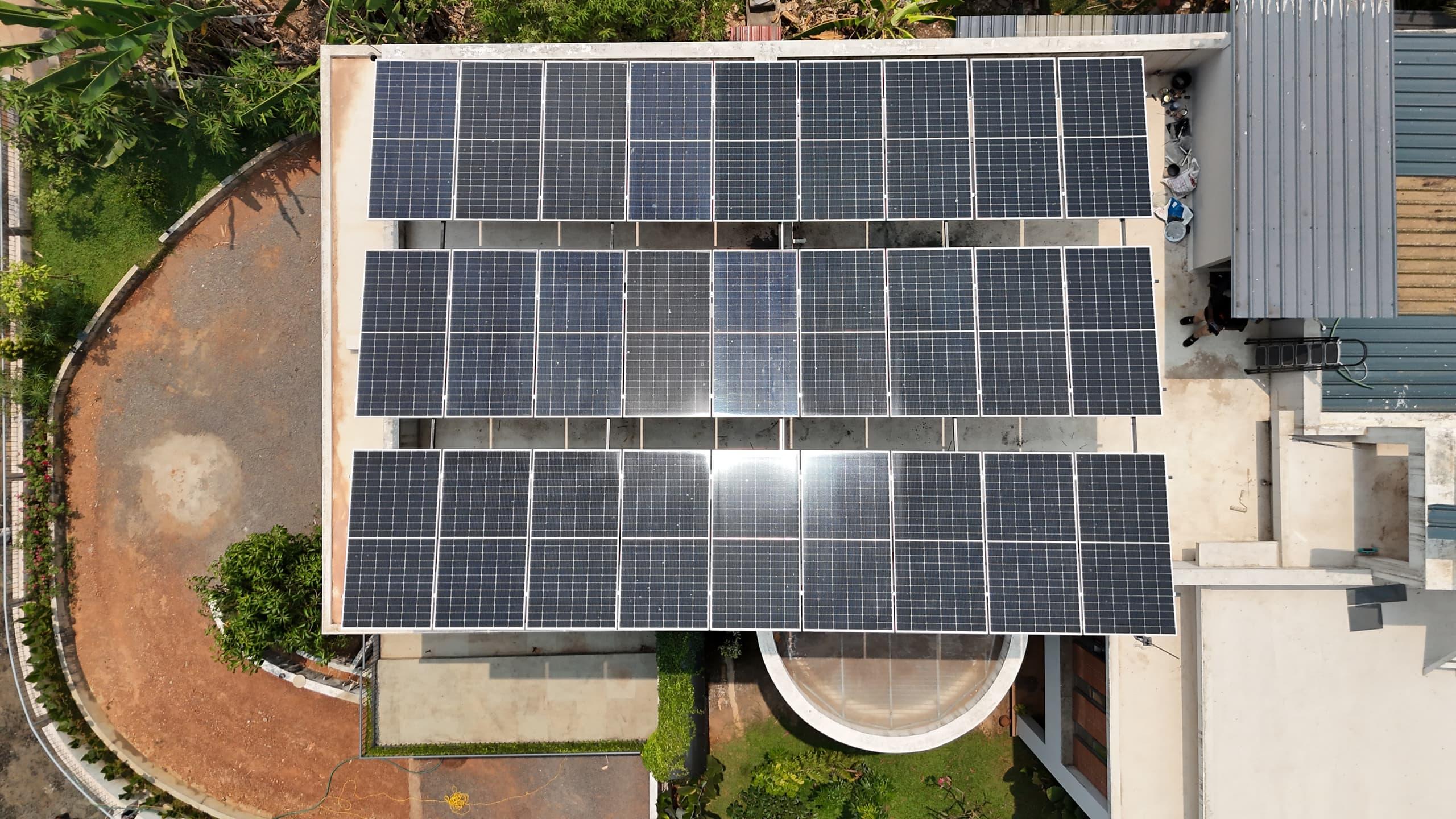
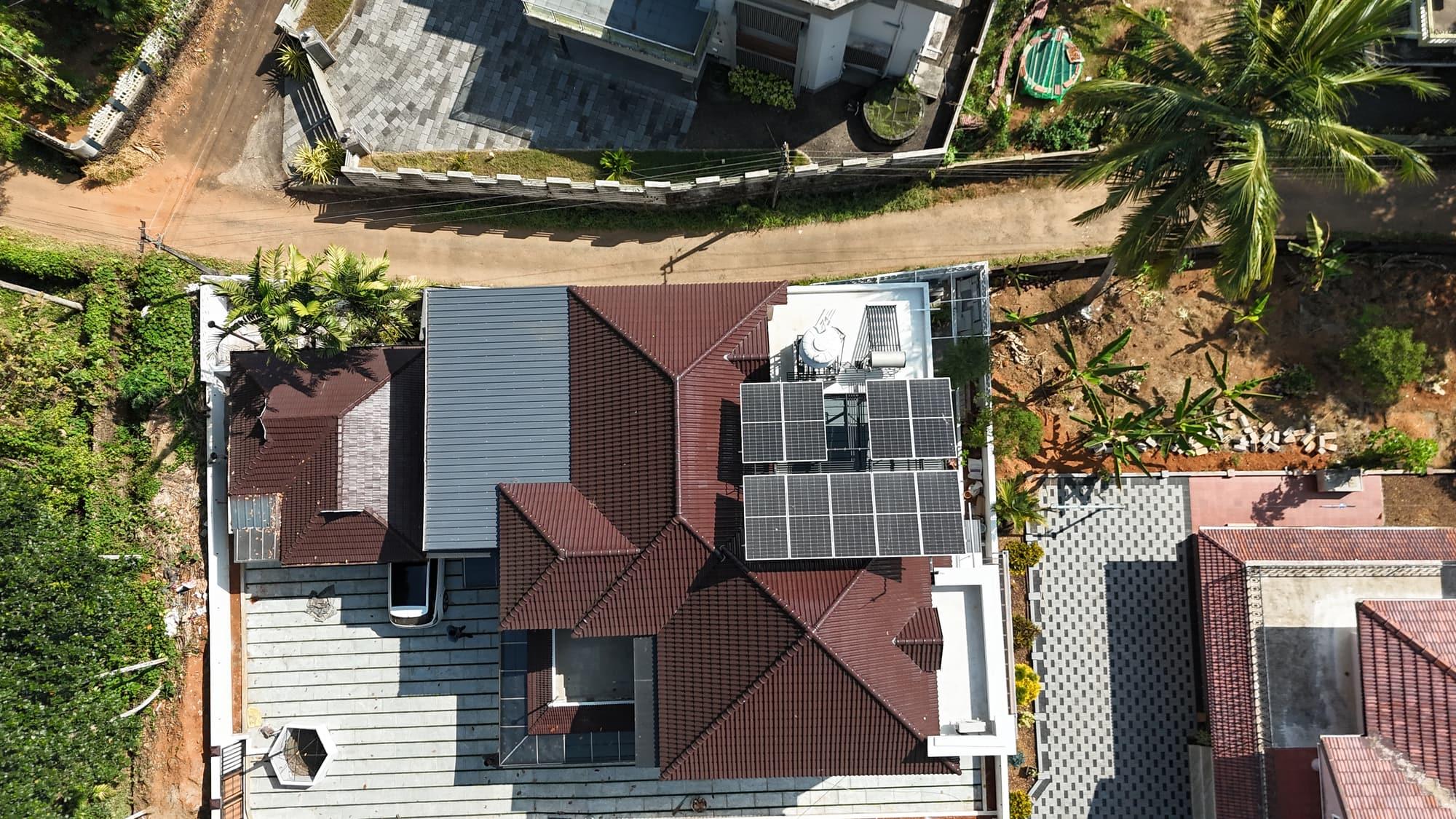
6 panels of 600 W · about 280 sq ft of roof · makes about 420 units a month
Saved every month
₹2,850
Pays for itself in
3.7 years
Saved over 25 years
₹7.96 lakh
- System price (3.5 kW × ₹58,000)
- ₹2,03,000
- PM Surya Ghar subsidy
- − ₹78,000
- Your cost
- ₹1,25,000
Indicative, not a quotation. A free roof survey measures shade, structure and your load and gives the exact system and price. This system would avoid about 4.1 tonnes of CO₂ a year.
How we work it out.
The same assumptions our engineers start from, before the roof survey replaces them with your real numbers.
The size
Your monthly units, from your bill and your rate, divided by about 120 units per kW, rounded up to the next half kW. From the roof, about 80 sq ft per kW. Panels are the 600 W modules we install today.
The saving
The units the system makes, never more than you use, at your own rate per unit. The 25-year figure lets the panels lose a little output each year and keeps the tariff flat, so it is on the cautious side.
The cost
On-grid at about ₹58,000 per kW before subsidy, less the PM Surya Ghar amount for your size. Payback is that cost divided by a year's saving.
Want the details? Read how much roof solar needs, solar prices in Kerala and the subsidy, stage by stage.
About the calculator.
It is an honest first estimate, built on Kerala averages: about 120 units a month from each kW across the year, monsoon included, and about 80 sq ft of shade-free roof per kW. Your roof's direction, shade and structure change the real numbers, which is why the free roof survey comes before any quotation.
Your bill is units multiplied by a rate, and KSEB's rate rises with consumption and differs for homes and businesses. Dividing your bill by the units printed on it gives your own rate. A higher rate means each unit of solar saves you more, so the system pays for itself sooner.
Under PM Surya Ghar, a home receives ₹30,000 per kW for the first 2 kW and ₹18,000 for the third, up to ₹78,000 for 3 kW or more. It applies to grid-connected home systems, on-grid and hybrid, and is paid to your bank account after KSEB commissions the system. Businesses and off-grid systems do not receive it.
Hybrid and off-grid prices depend mostly on the battery: its type and how many hours of backup you need. Rather than show a number that would be wrong for most homes, we quote those in writing after the survey.
Yes. Most nationalised banks give rooftop solar loans over 3 to 10 years, and the subsidy still comes to you. See Solar on EMI for how it works.
Want the real numbers?
One hour on your roof with our engineers, free, and the quotation is in writing.