

A rooftop solar plant carries a five-year installation warranty, but it is built to run for twenty-five to thirty years. That is a longer relationship than most people have with the builder of their house, and it deserves the same care in choosing who does the work. We filmed this at a 5 kW installation in Kannur, a long way from our Cherthala base, because the owner asked the questions below before hiring us and it seemed worth writing them down.
None of these checks are about price. Price is the last thing to compare, and the article on comparing two quotes covers that. These are the checks that tell you whether the company will still answer the phone in year six.
1. The name on the quote must match the name on the portal
PM Surya Ghar subsidy work can only be done by a vendor registered on the national portal, and the list is public. Look the company up. Then look at your quotation and, later, your invoice: the registered name and the billing name must be the same entity. If the quote comes from one name and the bill from another, the warranty chain is already broken before a panel goes up.
This matters for the equipment too. When a panel or inverter needs a manufacturer's warranty claim, the manufacturer asks for two things first: the warranty card and the invoice. Adani, for instance, will not send anyone to your roof; the claim goes through the installer who bought the panels, on the strength of proper paperwork. No invoice in the right name, no claim.
2. Deal with the company, not with a dealer
There are many people in the market who sell solar systems on behalf of installers, take a margin, and hand the job over. Some are honest. But when the after-sales call comes in year three, it is the installing company that has to respond, and a dealer who has moved on to selling something else adds a layer between you and the people who can actually fix things. Wherever you can, contract directly with the company that will put its own technicians on your roof.
3. Is there a system, or is there one person?
Ask who handles sales, who handles installation, who handles accounts and the KSEB paperwork. In a company with a process, those are different people or at least different roles, with records that survive one person's absence. In a one-person operation, everything lives in one phone. Everyone starts small, and small is not bad; but a one-person installer in Thiruvananthapuram servicing a roof in Alappuzha is a problem waiting for a monsoon.
Which leads to distance. A nearby installer, if a competent one exists, is worth a lot for service. If you choose a company from further away, choose one with the process above, so that a service request does not depend on one person's diary.
4. Go and see an installation
Every installer has finished sites. Ask to visit one, ideally one that is a year or two old rather than last month's. Look at the structure, the cable routing, the earthing, the labelling on the boxes. Then compare what you see with the components listed on your quotation: the same panel brand and wattage, the same inverter, the same protection devices. A quote that names good components and a site that shows different ones tells you what the company does when nobody is checking.
5. Compare quotes with GST included, on paper
A surprising number of quotes in Kerala are compared verbally, or on a WhatsApp message with no tax line. Insist on a written quotation with GST shown, and compare those. Proper billing is not bureaucracy; it is the document that makes every warranty claim possible for the next decade. A company that hesitates to give a full GST invoice is telling you how it will behave when a claim is inconvenient.
6. Transparency about components and margin
Solar installation is contracting work. Materials are sourced from several manufacturers, assembled into a working plant, and the company earns a margin on the whole. There is nothing to hide in that, and a good installer will tell you what every major component is and why it was chosen. What there is not is a magic way to sell the same components, installed to the same standard, at a price far below everyone else. The market has a fairly narrow band. An offer well outside it is hiding something, usually in the tax, the structure, or the cable.
7. Watch for the advertisement that keeps getting cheaper
Here is a pattern worth knowing. If an installer genuinely did good work at a very low price, referrals alone would keep them busy; they would not need to advertise. So when the same company runs a cut-price offer, then a few months later an even cheaper one, ask why the first batch of customers did not send their neighbours. The usual answer is that they grabbed customers with the price, ran into problems on those sites, and went back to advertising for the next batch.
8. Ask about the things that go wrong
Ask what happens when the inverter fails in year four, how long a replacement takes, whether they keep a standby unit. Ask how they handle a KSEB inspection that finds a fault. Ask whether they have relocated a system when a roof was re-laid. An installer who has done this for years has stories; one who has not will change the subject.
The Kannur site that prompted this
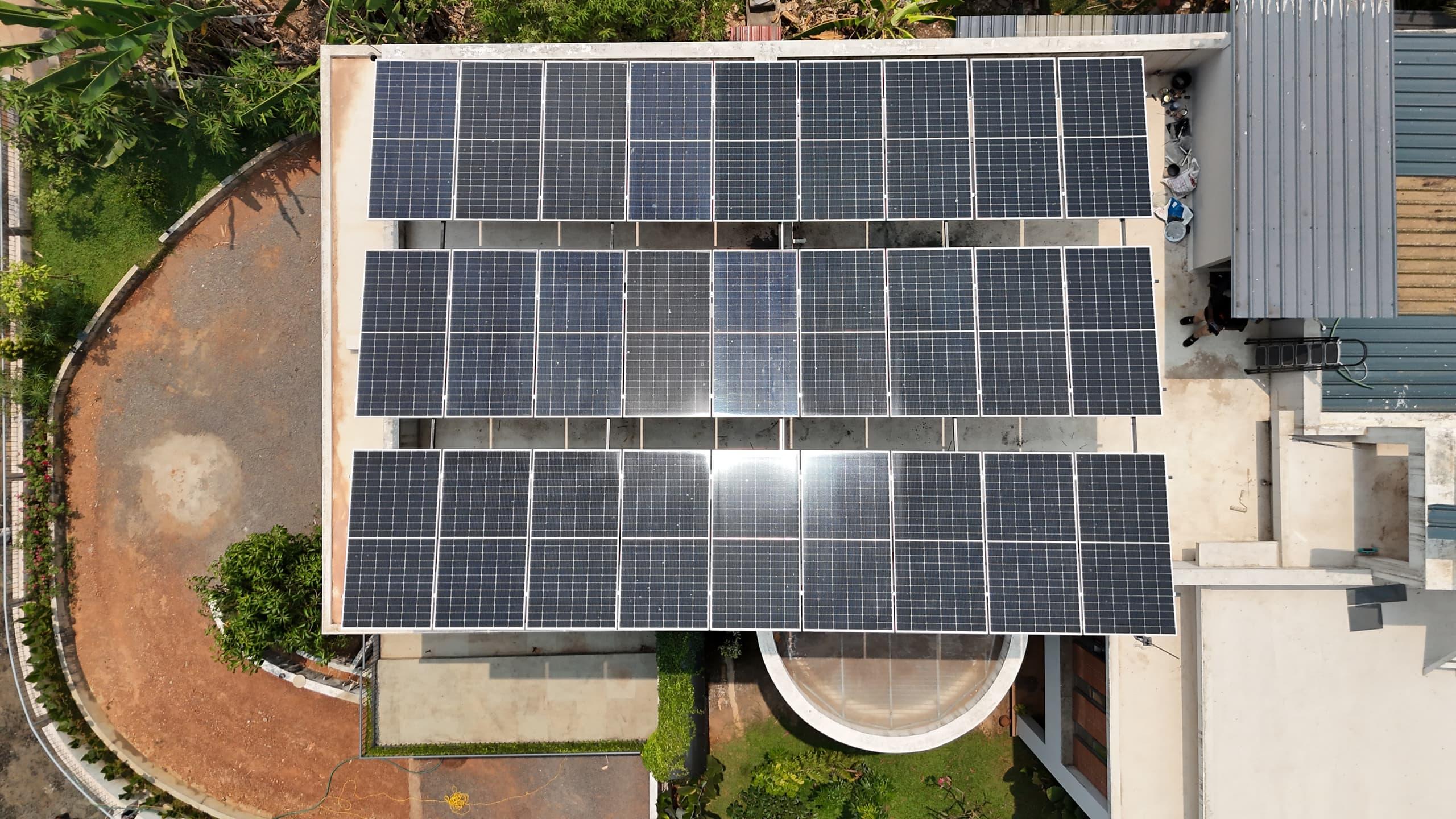
The owner, Aneesh, runs a jewellery business with two shops and told us on camera that his combined household and shop bills came to about ₹25,000 a month. He had originally planned a 20 kW plant and, when the regulatory picture shifted, decided to start with 5 kW at home and expand later. The system is nine Adani 545 W panels on an elevated structure over a flat roof, in a single string with clear sun from about eight in the morning to five in the evening, with a stainless steel lightning arrester and down conductor. He added an electric car after the install.
His own numbers: the house alone used to bill about ₹8,000; after solar, charging the EV, the bill came to nil apart from fixed charges. His subsidy was credited, and he took a two-lakh solar loan at a rate he described as six percent, with our staff coordinating the bank and KSEB paperwork so that he only had to sign. His neighbour Suresh, who watched the job, had a 5 kW system fitted next door soon after; his bill had been about ₹7,000.
Those are the owner's figures, not ours, and your roof will differ. The point of the site is the process: verified vendor, proper paperwork, a visit from the neighbour, and a referral that followed. That is how a solar company should grow, and it is the easiest test of whether the one you are talking to has.
Your roof, next
Want these numbers for your own house?
A free one-hour roof survey by a SEDNA engineer. Honest size, subsidy filed, quote in writing.
- 4.9 on Google
- 2,500+ installations
- MNRE-approved
- Since 2009