

This guide is the written version of conversations we have had on thousands of Kerala rooftops since 2009. It is long on purpose: by the end you should understand your own project well enough to question any installer, including us. Read it straight through, or jump to the section you need.
Why Kerala is quietly excellent for solar
Kerala's brand is rain, but its physics are sunshine. Most of the state receives generous solar irradiance for eight to nine months a year, and a well-placed system averages roughly 4 units per kilowatt per day across the whole year, monsoon included. What makes the economics work is not just the sun but the tariff: Kerala's domestic electricity slabs climb steeply, so heavy-consuming homes pay some of the most expensive marginal units in the country. Solar removes exactly those expensive units first.
Add the central subsidy of up to ₹78,000, net metering that banks your excess with KSEB, and panel prices that have fallen for a decade, and the typical payback for a Kerala home now lands between 3 and 5 years, on equipment warrantied for 25.
How a rooftop system actually works
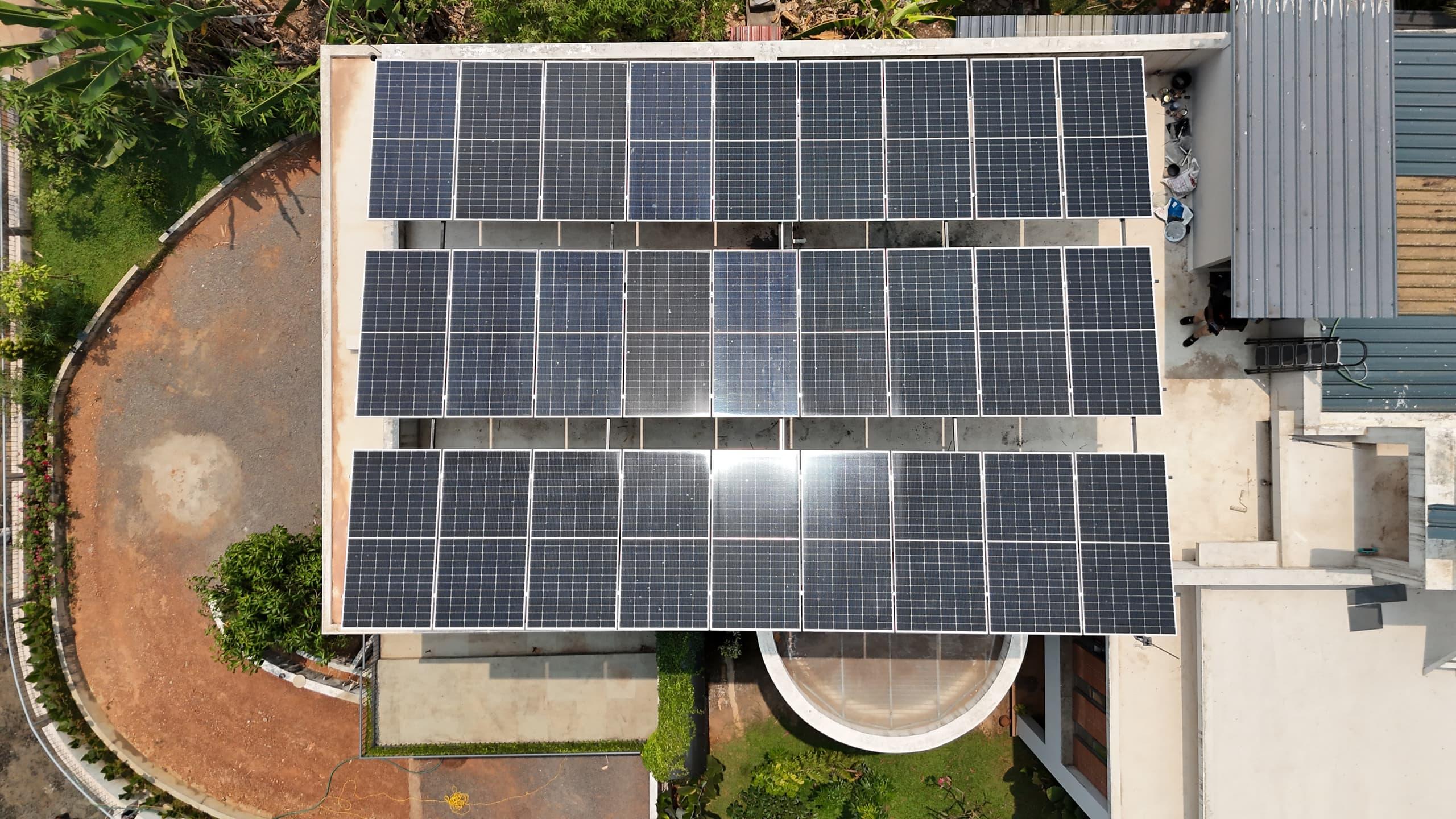
Panels on your roof convert sunlight to DC electricity. An inverter converts that to the AC your home uses. Your appliances consume what they need the moment it is made; whatever is left over exports through a bidirectional meter to the KSEB grid, where it is banked as credit. At night you draw from the grid as usual, and the billing cycle settles imports against exports. That is the whole machine: no moving parts, nothing to refuel, one box to service.
The practical consequence is that solar pays best when the system is sized to your actual consumption. Oversizing wastes capital on exports that earn less than self-consumed units save; undersizing leaves expensive slab units alive on your bill. This is why honest sizing is the heart of a good quote.
On-grid, off-grid or hybrid: the sixty-second version
On-grid is the default for most homes: cheapest per kW, no batteries, subsidy eligible, but it switches off during power cuts for lineman safety. Off-grid runs entirely on batteries and never notices a power cut, at meaningful extra cost and 5 to 6 year battery replacement cycles. Hybrid sits between: it exports like on-grid but keeps essential circuits alive from a battery during outages.
The honest selector is one question: how often does your specific area lose power, and for how long? Rare, short outages point to on-grid. A few dark evenings a month point to hybrid with a modest battery. Genuinely unreliable supply points off-grid. We cover this in depth in our system comparison guide, and your survey should answer it for your exact locality.
What it costs, and what the subsidy does
As a working range in 2026, budget in the region of ₹55,000 to ₹65,000 per kW installed for a quality residential on-grid system, before subsidy, varying with panel technology, structure complexity and inverter choice. PM Surya Ghar then contributes ₹30,000 per kW for the first two kilowatts and ₹18,000 for the third, capping at ₹78,000 for 3 kW and above, paid directly to your bank account after commissioning.
The arithmetic for the most common home size: a 3 kW system in the low two lakhs gross, minus ₹78,000 subsidy, financed if you wish with solar loans whose EMI typically lands near the electricity bill you were already paying. From that point the system is, in effect, buying itself. Our detailed price guide breaks this down size by size, and the calculator on our homepage runs the numbers for your own bill.
Choosing panels and inverters without a physics degree
Panels: insist on ALMM-listed brands, and if you are claiming the subsidy, they must also be DCR panels, made in India cell and module. Mono PERC is the current mainstream; TOPCon is the newer higher-efficiency option, mostly in non-DCR imports today. Wattage per panel matters because roof space and mounting points cost money: fewer, stronger panels usually win.
Inverters: this is the hardest-working component and the one that will use its warranty. Stay with established brands, match inverter capacity honestly to array size, and prefer a model whose monitoring app you will actually open. We install and service Growatt, GoodWe, Sofar and Hitachi among others, and the right choice depends on system size and budget rather than loyalty.
Choosing an installer: the questions that filter the field
Ask how many years the company has operated under the same name, and ask to see a system they installed five or more years ago along with its owner's phone number. Ask who answers the service phone and what the written response-time commitment is. Ask whether they file the subsidy and net metering paperwork themselves. Ask what mounting structure they use and what wind speed it is engineered for, a question that matters more in coastal Kerala than almost anywhere.
Then read the quotation line by line against our quote-comparison checklist. The kilowatt number is the least informative line on the page; the inverter model, structure specification and protection devices are where cheap quotes hide their cuts.
The process, week by week
Week one is the survey and design: roof measurement, shadow mapping across the day, load study, then a written quotation naming every component. Week two is paperwork: the PM Surya Ghar application and KSEB feasibility, filed against your consumer number while materials are procured. Weeks three and four are the physical installation, typically 2 to 3 days on the roof, followed by KSEB inspection, bidirectional meter installation and commissioning. Subsidy transfer follows commissioning, usually landing within 30 to 90 days.
The step that most often slows a project is not on the roof at all: it is bidirectional meter availability at the local KSEB section office. A good installer follows that file so you do not have to.
Life after installation
Your duties are small: glance at the monitoring app monthly, compare generation with the same month last year, and keep the panels clean in the dry season. The system's duties are smaller still: sit on the roof and turn sunlight into money. Panels degrade slowly, well under one percent a year for quality modules; inverters typically earn one service intervention in their first decade; and a yearly professional check keeps warranties clean and output on its curve.
Our service records show what this looks like over time: a four-year-old 5 kW system with 23,000 units on its counter, and eight-year-old installations still on their degradation curve. That is the real promise of rooftop solar in Kerala, and it is measured in inverter counters, not in brochures.
Where to go from here
If your monthly bill is above roughly ₹2,000, the numbers deserve a look. Use the savings calculator on our homepage for a first estimate, read the subsidy and scam-alert guides before talking to any installer, and when you are ready, book the free roof inspection. One hour on your roof answers every question in this guide with your own numbers.
Your roof, next
Want these numbers for your own house?
A free one-hour roof survey by a SEDNA engineer. Honest size, subsidy filed, quote in writing.
- 4.9 on Google
- 2,500+ installations
- MNRE-approved
- Since 2009