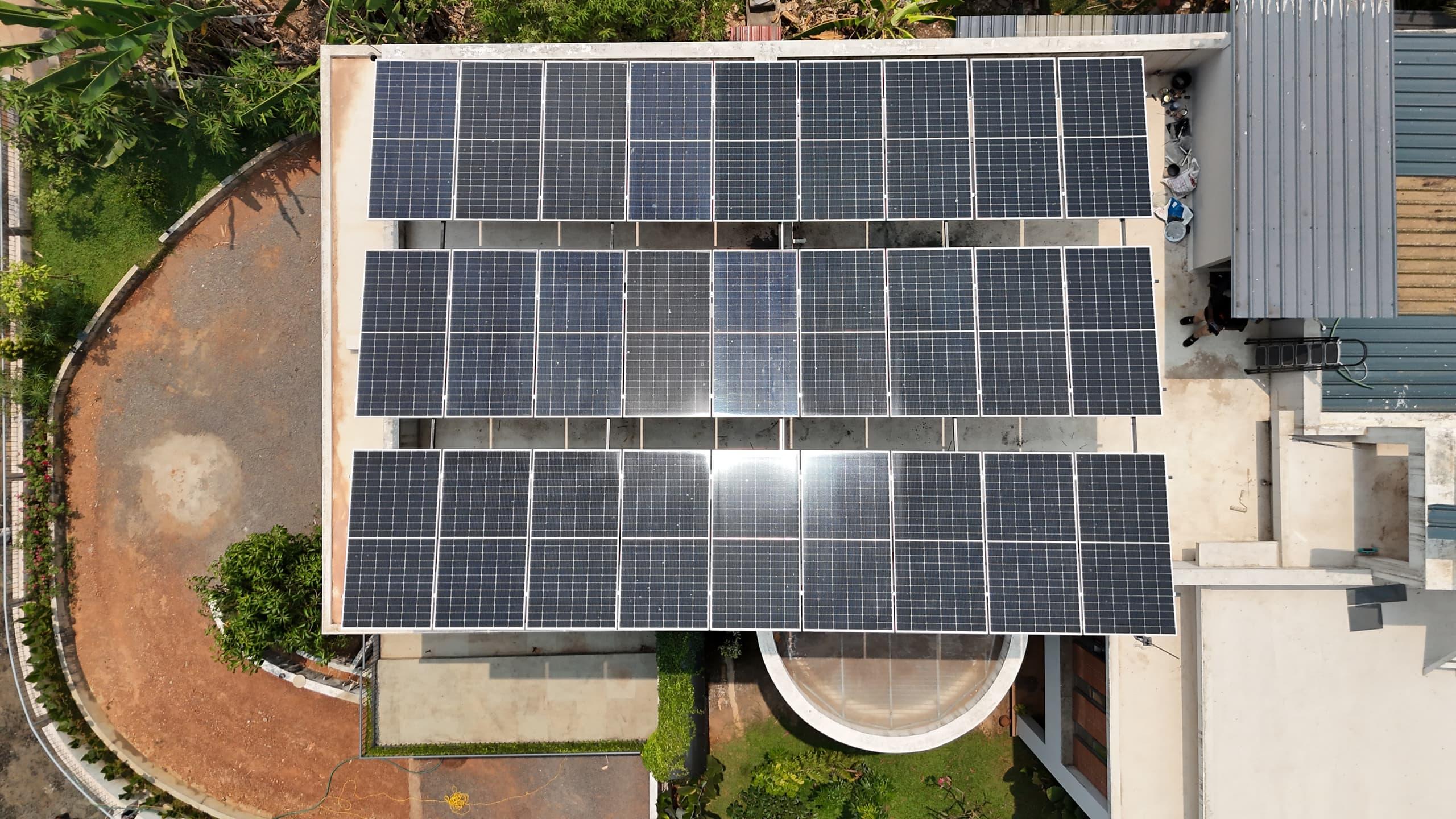


Most solar companies in Kerala refuse to publish prices, which forces families to collect quotes blind. We think that secrecy serves installers, not customers. These are honest working ranges for quality residential systems in 2026. Your exact quote will differ with your roof and choices, and we explain exactly which factors move it.
Working price ranges in 2026
For a quality on-grid system with ALMM-listed DCR panels, branded inverter, engineered structure and full protection devices, budget roughly ₹55,000 to ₹65,000 per kilowatt installed. In practice: a 2 kW system lands near ₹1.1 to 1.3 lakh gross; 3 kW near ₹1.7 to 2 lakh; 5 kW near ₹2.8 to 3.2 lakh; 10 kW near ₹5.5 to 6.2 lakh. Larger systems cost less per kW because fixed costs spread across more panels.
Now the subsidy: ₹60,000 back on a 2 kW system, ₹78,000 on 3 kW and above, paid to your account after commissioning. Net of subsidy, the popular 3 kW home system therefore lands in the region of ₹1 to 1.2 lakh, which is the number to hold in your head. Hybrid systems add the battery: expect roughly ₹25,000 to ₹50,000 more per kWh of quality lithium storage depending on brand and configuration.
What moves a quote up or down
Panel technology: TOPCon and higher-wattage modules cost more per panel and less per roof. Structure: a flat concrete roof with a simple layout is the baseline; elevated structures, tile roofs needing careful mounting, and coastal wind-rated engineering add real material and labour. Inverter tier: entry brands and premium brands can differ by tens of thousands at 5 kW and above. Cable runs: a roof far from the meter room costs more copper. None of these are padding; all of them should be visible as line items.
The EMI way of thinking
Solar loans are widely available, and the arithmetic is friendlier than most expect. A 3 kW system netting around ₹1.1 lakh after subsidy, financed over five years, produces an EMI in the neighbourhood of ₹2,000 to ₹2,400 a month, which is close to the KSEB bill it replaces for a typical qualifying home. You are not adding an expense; you are redirecting one, and after the loan closes the electricity keeps coming for another two decades.
Price per unit: the 25-year view
Spread a 3 kW system's net cost across a conservative 25-year output and the electricity works out around ₹1.50 to ₹2 per unit, versus domestic slab rates several times higher and rising. That per-unit framing is the truest price of solar, and it is the reason payback keeps shortening every time KSEB revises tariffs upward.
What suspiciously cheap quotes are hiding
When a quote undercuts the market by a lakh, the money comes from somewhere: unlisted or non-DCR panels sold as subsidy-eligible, an inverter one size too small, a structure that will meet its first cyclone warning badly, missing earthing and surge protection, or a service department that consists of a SIM card. Our quote-comparison guide walks every line; the shortest version is that the inverter model and structure specification are where to look first.
Prices here are indicative for standard residential installations and move with the market; your written SEDNA quotation after a free survey is exact, itemised and honoured. That is the difference between a price range and a price.
Your roof, next
Want these numbers for your own house?
A free one-hour roof survey by a SEDNA engineer. Honest size, subsidy filed, quote in writing.
- 4.9 on Google
- 2,500+ installations
- MNRE-approved
- Since 2009