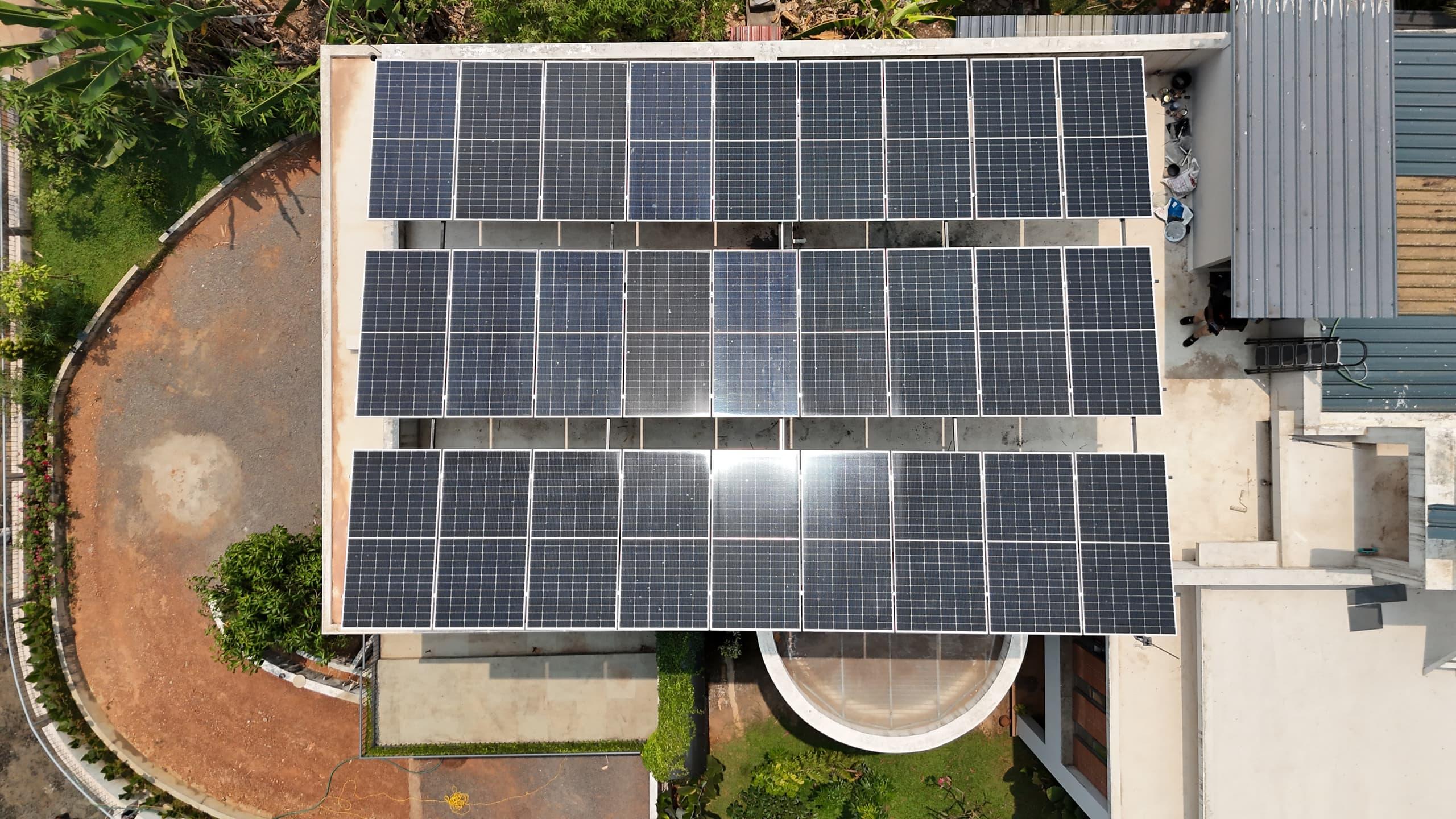


Solar car is the phrase both of these owners used, and it is not far wrong. Neither car has a panel on it; both are charged at home from a rooftop system that was sized with the car in mind. The two films remain the most watched on the SOLARKART channel by a distance, because they answer the question every EV buyer in Kerala asks: can the roof really run the car? Here is what each owner reported, and the arithmetic that makes it work.
The doctor's Nexon EV on 5 kW
A doctor in Kerala installed a 5 kW on-grid system at his residence and reported a daily generation of about 23 units, which is toward the upper end of what 5 kW does here and speaks to a clean, unshaded roof. The house runs on it during the day, and the Tata Nexon EV charges from it. The film's title puts it as 300 km free, which is the owner's way of describing a full charge from the roof.
The arithmetic he used is worth repeating because it applies to any home. A 5 kW plant making 20 units a day, the conservative figure, is 600 units a month. A Nexon EV of that generation carries a battery of roughly 30 kWh and travels about 6 to 7 km per unit in real Kerala driving. So a monthly 1,000 km of driving needs about 150 to 170 units, a quarter of the plant's output, and the remaining 430 or so units run the house. The comparison the owner made was between the four things a household buys energy for, petrol, diesel, cooking gas and electricity, and which of them the roof displaces most cheaply. Petrol won by a wide margin.
The businessman's MG ZS EV on 10 kW
The second owner runs a larger house and drives a great deal more. A 10 kW system at his residence generates about 45 units a day by his account, and in the five months after taking delivery of an MG ZS EV he had driven 32,000 km, effectively all of it charged at home. That is over 6,000 km a month, far above normal use, and it is why he sized at 10 kW rather than 5.
At 6 to 7 km per unit, 6,000 km a month is close to 900 to 1,000 units for the car alone, most of a 10 kW plant's monthly output. His report was that the electricity bill stayed manageable with the house and the car on the same roof, which is consistent with the numbers, and he had recommended the arrangement to colleagues. Two things make his case unusual: the mileage, and a roof that could take 10 kW. For most homes, the doctor's 5 kW is the more representative picture.
What both cases have in common
Both charge in daylight when they can. This is the whole trick. An on-grid system exports daytime surplus to KSEB and you draw it back at night through net metering, so charging at night still works. But charging in the day uses the roof's output directly, skips the metering round trip, and matters more under Kerala's 2026 net-metering rules, which settle banked surplus at a regulated rate rather than one-for-one. A car plugged in from mid-morning to mid-afternoon, on the days it is at home, is the cheapest kilometre you can buy.
Both sized the roof for the car, not just the bill. A car adds a large, steady load to a household. If you are installing solar and expect to buy an EV within the system's life, say so at the survey: the inverter and the structure can be sized with the headroom, and the difference in cost now is far smaller than an upgrade later. The EV charging arithmetic guide works through the sizing in detail.
And both were early. These films date from 2020 and 2021, when an EV in a Kerala driveway was unusual. The numbers they reported then are the numbers we see across many more homes now, and the case has only strengthened as EV prices have fallen and petrol has not.
Your roof, next
Want these numbers for your own house?
A free one-hour roof survey by a SEDNA engineer. Honest size, subsidy filed, quote in writing.
- 4.9 on Google
- 2,500+ installations
- MNRE-approved
- Since 2009