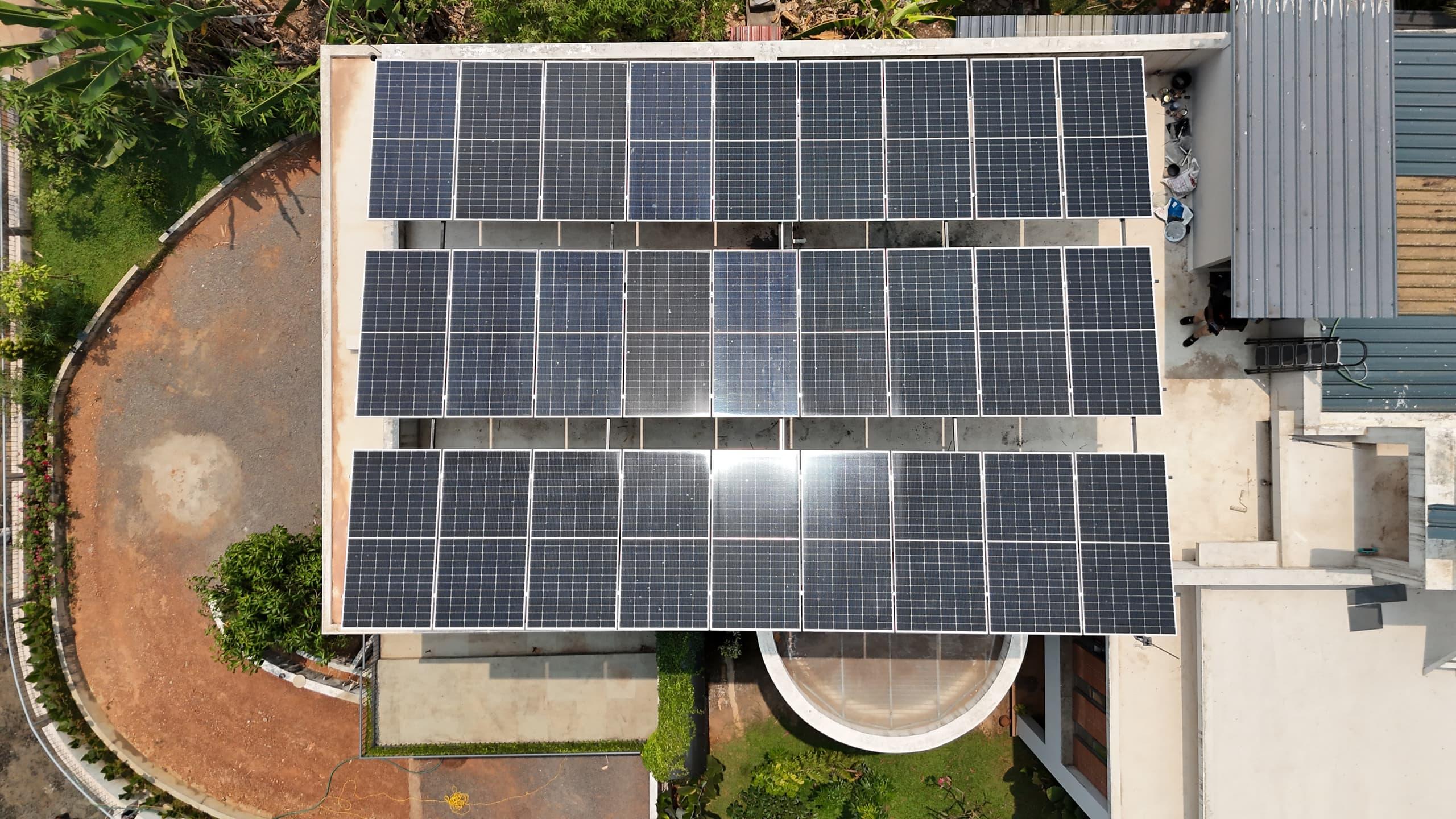


The numbers below are what owners said on camera in videos recorded for SEDNA's channel between 2024 and 2026. They are their figures, not ours; we have not audited their bills, and every roof and household is different. What they show together is the shape of the change, and the things beyond the bill, service calls, breakdowns, paperwork, that owners bring up when they are asked how it went.
Shambhu, Pallippuram, Alappuzha: 3 kW since 2020
An engineering consultant who works in the Philippines and installs industrial solar there, Shambhu put 3 kW on the family home in 2020, when there was no subsidy, because a two-month bill of about ₹8,000 made the return certain. His bills now run around ₹100 to ₹150 a cycle, rising to ₹500 or ₹600 when the family is home and the air conditioners run. He reports about 14 units a day, 12 on rainy days. In five years the roof was re-laid with a truss and the panels had to be relocated; the inverter failed once and was replaced under warranty; the panels are cleaned every six months. His advice: study your consumption first, and if you have an EV or plan to cook on induction, size for it.
A retired principal, Thevara: 4 kW, and money back
He had seen a large solar plant installed at the college he ran ten years earlier and chose solar for his home on retiring, picking a local company after speaking to many in Ernakulam. Before: ₹7,000 to ₹8,000. After: only the meter rent, and in addition ₹4,000 credited back in the first year and over ₹7,000 in the second for surplus export. He installed without subsidy and says the first two years' credits exceeded what a subsidy would have paid. He added three air conditioners after the system went in. His figures: up to 21 units on the best days, 16 to 17 on average, against household use of 8 to 12. What he stressed most was periodic inspection that happens without his asking, after a bad experience with the agency at the college.
Dr Santhosh, Kanjikuzhi: a nalukettu and a KSEB earth fault
A doctor working in Mumbai, with a 2018 nalukettu house whose pitched roof he would not allow panels on. The system was built on a separate structure. Bills of ₹7,000 to ₹8,000 fell to ₹300 to ₹325 a month. The interesting part is what went wrong: generation was fine but power was not reaching the KSEB feeder properly. Our team replaced a cable, found that was not the cause, and traced it to a faulty earth on the local KSEB transformer, which was fixed after we took it to the section engineer. His subsidy reached his account on the eighteenth or nineteenth day after the paperwork, all of which he signed and we filed.
Binoy, Ernakulam: from on-grid to hybrid, with wheeling
Binoy's first system was a 5 kW hybrid at a project in Ernakulam three years ago, averaging above 20 units a day, with the surplus wheeled to a second connection in his own name. His new house has automated gates and equipment that must run through an outage, and the on-grid arrangement at the old property had left him without power during cuts; the new system is a hybrid. He shortlisted companies by reading customer feedback online and came back to the same one for the second project because of how the first was serviced.
Amal, Kalavamkodam: 3 kW, four months in
A bill of about ₹2,500 that kept rising as the family bought appliances. Four months after a 3 kW on-grid system, built so it can grow to 4 kW, the KSEB demand is the basic ₹170 of meter rent and fixed charges; one cycle a credit balance meant nothing was payable, and 58 surplus units were sitting in the bank. He chose the installer nearest his house for service reasons and is planning an electric vehicle.
Aromal: ₹4,000 to under ₹200
Bills of ₹3,500 to ₹4,500 fell to ₹166 to ₹172. He has AC and television, and plans to switch to an EV to bring a ₹15,000 monthly petrol spend onto the same roof. The installation took about a week including KSEB feasibility, all handled without him leaving the house, and he says service calls, even small ones, are answered within the hour. Several friends and family have installed on his recommendation.
Rajesh: three ACs, a Tata Punch EV, zero bill
Back from years abroad, Rajesh got a ₹12,000 bill running three air conditioners in summer. After solar, and after buying a Tata Punch EV that he charges on alternate days, his bill is the minimum charges only. The one delay was KSEB's meter; the one fault was an inverter complaint, handled by fitting a standby inverter the same day and returning the repaired original later.
Dileep, Cherthala: house plus shop, ₹2,500 to ₹142
Secretary of a cooperative society, with a small shop his wife runs. The combined bill was ₹2,500 to ₹3,000 and the last one was ₹142. He chose a Cherthala company deliberately, so that a problem could be dealt with in person, and mentions that the bank loan paperwork was handled by our staff and sanctioned quickly.
Arabia Begum: ₹4,000 to ₹5,000, now ₹100 to ₹200
A retired teacher whose bills reached ₹4,000 to ₹5,000 after air conditioning went in. Now ₹100 to ₹200. She spoke mostly about the people: the staff member who explained the scheme, and the technicians who did the work.
Jaimy Jacob, Edakochi: 5 kW, one month in
A businessman with bills of ₹6,000 to ₹7,000. One month after a 5 kW system his bill showed only the old arrears and no new energy charge; the true surplus will show after a full cycle. He reports over 24 units on good days from 5 kW, two days for the structure, two for the fitting, and KSEB connection within two weeks.
What the ten have in common
Every one of them went from a bill in the thousands to one in the low hundreds, and the hundreds are fixed charges, meter rent and duty, which solar does not remove. Several installed without subsidy and say the return justified it anyway; the ₹78,000 available today makes the case easier. Almost all added load afterwards, air conditioners or an EV, which is the real economic story: solar did not just cut a bill, it let the household use more electricity without fear of it. And when asked what mattered, more of them talked about the service call than the bill. That is the part of the decision no calculator shows you.
Your roof, next
Want these numbers for your own house?
A free one-hour roof survey by a SEDNA engineer. Honest size, subsidy filed, quote in writing.
- 4.9 on Google
- 2,500+ installations
- MNRE-approved
- Since 2009