

Mala, in Thrissur district, is farming country, and this house is a long way from its transformer. While our team was on site the supply voltage sat between 190 and 204 volts, and daytime power cuts are routine. That combination decides the technology before anything else does. An on-grid inverter needs the grid to be present and within a voltage window; below the window it disconnects for safety and stops generating. On this line it would have spent a good part of every day tripped, producing nothing while the panels sat in full sun.
The system
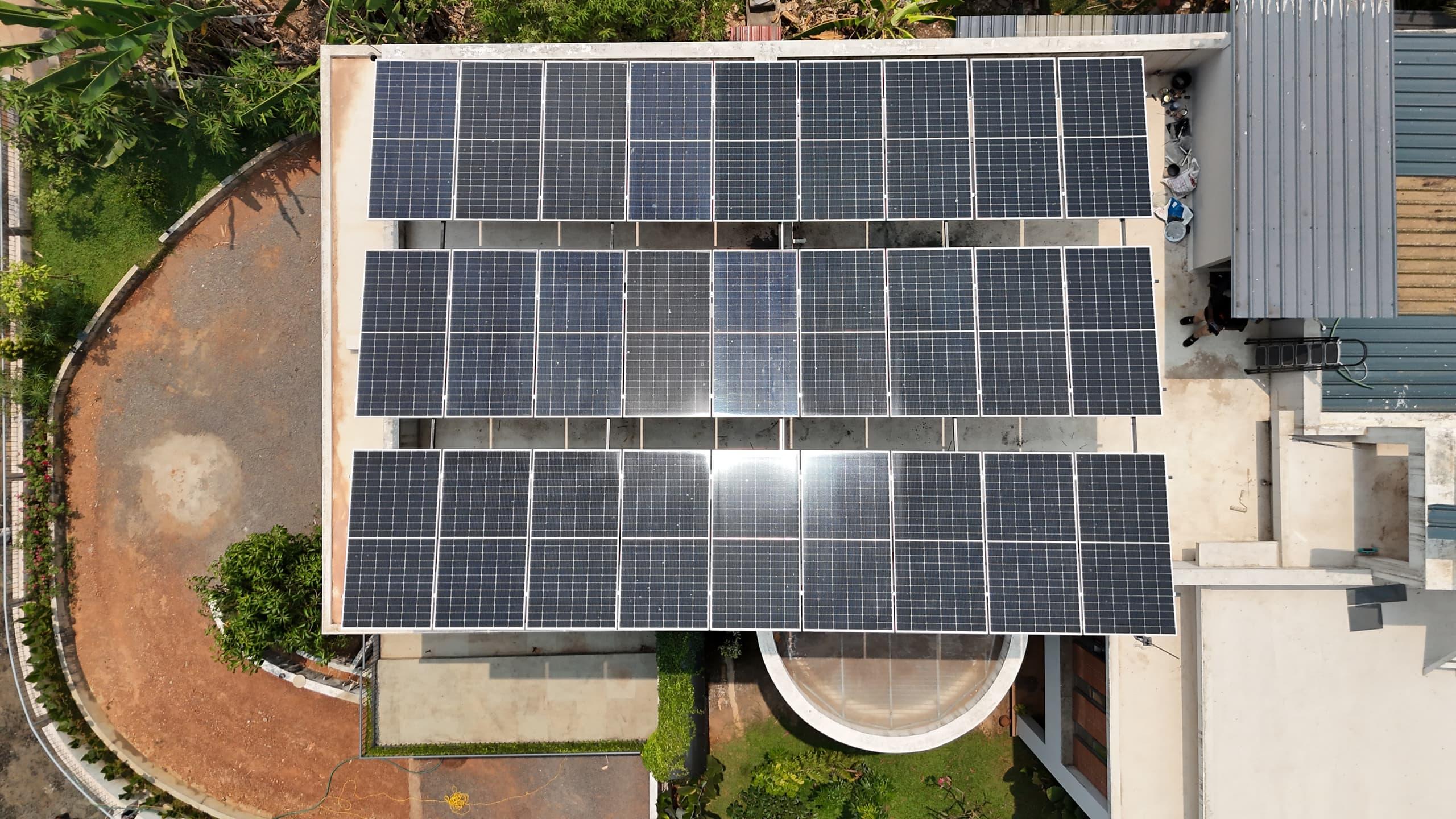
A 5 kW hybrid with ten Luminous 540 W panels on a south-facing sheet roof pitched at 12 to 13 degrees, mounted on a short rail with a walkway down the middle, in two strings of five. Four Exide 200 Ah C10 tubular batteries, a category rated for solar cycling rather than ordinary inverter use. A DC distribution box with surge protection earthed through its own conduit, a 32 A MCB on the AC side, and a Deye hybrid inverter. The order came in, the work was completed within a week, and on the day we returned to configure the system KSEB had already installed the net meter: single-phase connections in this area were being approved quickly at the time, despite meter shortages elsewhere.
Why the hybrid earns its cost here
A hybrid stores generation for the house's own use and exports only the surplus, and it keeps working through a grid that an on-grid inverter would refuse. Voltage sag in villages and voltage shoot-up in town areas are both increasingly common, and in either case the on-grid inverter's protective disconnect is doing its job while costing the owner units. Where the owner also needs backup, because the cuts hit during working hours, a hybrid is the only design that solves both problems at once.
The cost side is honest: a hybrid inverter and a battery bank together add substantially to a 5 kW system, and we expect that gap to narrow as lithium prices fall. Whether it is worth paying today depends on the owner's pattern, and the pattern that justifies it is exactly this one: heavy use, unreliable supply, work that cannot pause.
Hybrids qualify for the subsidy
A common misconception is that PM Surya Ghar covers only on-grid systems. It does not. A hybrid connected to the grid through a net meter is a grid-connected rooftop plant, and this Mala system was done under the scheme. The central assistance is ₹30,000 per kW for the first two kilowatts and ₹18,000 for the third, so ₹78,000 for 3 kW and above; a 5 kW or 10 kW system receives the same ₹78,000. The subsidy applies to the solar plant; the battery bank is the owner's cost.
Three kilowatts is where the subsidy is most efficient, and where the generation, around 12 units a day, starts to be useful for a household of any size. Below that, the numbers rarely justify an on-grid or hybrid investment at all.
Why we do not quote prices in these articles
Every video like this collects the same comment: why hide the price? We do not hide it; we quote it on the day, for the site. Panel and battery prices move month to month, and an article is read a year after it is written. A figure that was true on the filming day misleads the reader who plans on it later. Ask us and you will get the number that is true today.
On the display at half past one on a cloudy afternoon: 2.96 kW coming off the roof, 1.78 kW going out to KSEB, the house drawing almost nothing, the bank at 62 percent and charging. On a line that could not have supported an on-grid inverter at all, that is the argument for the design.
Your roof, next
Want these numbers for your own house?
A free one-hour roof survey by a SEDNA engineer. Honest size, subsidy filed, quote in writing.
- 4.9 on Google
- 2,500+ installations
- MNRE-approved
- Since 2009