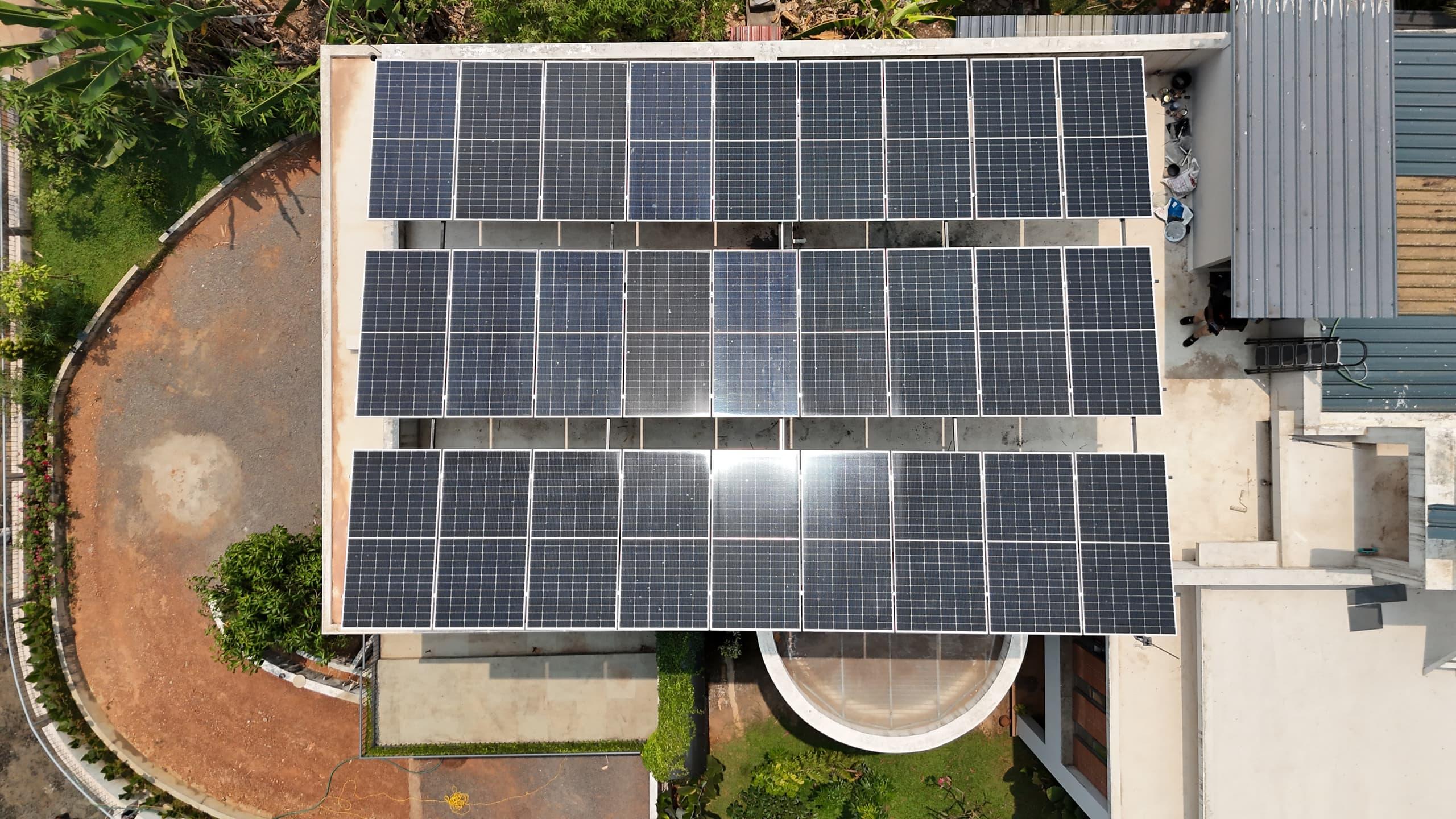


This villa sits beside the national highway near Nedumbassery airport, a town area with a decent supply, and the owners still chose a hybrid. Both work in IT from home, and a power cut or a voltage dip in the middle of a working day is not an inconvenience for them; it is lost work. That single requirement drove every design choice on the site, and because the inverter is unusually flexible it is a good place to explain what a modern hybrid can be told to do.
The hardware
A 5 kW Deye hybrid inverter with two MPPT inputs, fed by two strings from the roof. A 48 V battery bank of four Exide 150 Ah tubular batteries with a five-year replacement warranty, at 2024 prices roughly ₹65,000 for the pack. An AC distribution box with a surge protection device across it and an earth bench beside the inverter bonding every metallic part. Two isolators on the battery cable so that the bank can be disconnected in an emergency. And a changeover switch in the house distribution board, so that if the inverter itself ever fails the owner can bypass it and put the house straight back onto KSEB without waiting for a technician.
That last item is one we fit on every hybrid. A hybrid sits between KSEB and the house, which is what lets it hold the house up in a cut; it also means an inverter fault would otherwise take the house down. The changeover is the insurance.
Running without batteries
Here is the feature that changes how people budget. This inverter runs in a no-battery mode as a plain on-grid inverter. You can install the panels and the inverter now, export to KSEB, and add the battery bank when finances allow, with no rewiring. Equally, an owner who installs a hybrid for backup and later decides the batteries are not worth replacing at year eight can keep running on-grid. Until the bank is fitted there is no backup, but the option is there.
How it decides where power goes
By default the inverter sends solar to the house first, then to charging the battery, and only exports to KSEB what is left after both. Every part of that is programmable. Battery charging can be given priority over the house. The depth of discharge can be set, so the bank never goes below a chosen percentage. Charging from the grid can be forbidden, or allowed only in a chosen window. A generator input can be synchronised. And the schedule can differ by day of the week: a household that is out on Sundays can tell the inverter to discharge deeper on weekdays and hold the bank on Sundays.
The battery charging current is also set by the installer to suit the bank; on 150 Ah batteries we limit it to around 25 to 30 amps. A temperature sensor cable on the batteries feeds their temperature back to the inverter, which adjusts charging with it.
Headroom for today's panels
The current generation of this inverter accepts 18 amps per MPPT input, up from the 15 amps of models a couple of years earlier. That matters because the TOPCon N-type panels now standard on our sites deliver more current than the panels the older inverters were designed for. It charges and discharges at up to 120 amps, and three or four more identical battery packs can be added in parallel later, so the site can grow into a much larger store without changing the inverter.
Zero-export until the meter arrives
When we filmed, the villa did not yet have its KSEB connectivity; the application was in and the meter was two or three weeks away. Rather than leave the system idle, it was running in zero-export mode. A CT coil on the KSEB line feeds the inverter, which throttles generation so that nothing crosses into the grid. On the display at one in the afternoon, in strong sun, the panels were producing only 670 W, because the house was drawing little and the bank was already at 63 percent. The moment the meter is fitted the setting is removed and full export begins. Until then the family had, in effect, an off-grid system with a grid backup, which is exactly what they wanted.
What the display and the app show
Four panels on the inverter screen: solar, battery, grid, load. Solar shows total power, each string's voltage and current, today's and lifetime generation, with a daily bar graph. Battery shows state of charge, voltage, charging current and temperature. Grid shows voltage and whether the inverter is buying or selling, with lifetime import and export. Load shows what the house is drawing. It is one of the few inverter interfaces a non-technical owner can read at a glance, and the same data is available anywhere through the SolarMan app, where the owner can also change the parameters above without a site visit.
A hybrid is a more expensive system than on-grid, and for many Kerala homes on-grid remains the right answer. For a household whose income depends on the lights staying on, this is what the extra money buys.
Your roof, next
Want these numbers for your own house?
A free one-hour roof survey by a SEDNA engineer. Honest size, subsidy filed, quote in writing.
- 4.9 on Google
- 2,500+ installations
- MNRE-approved
- Since 2009