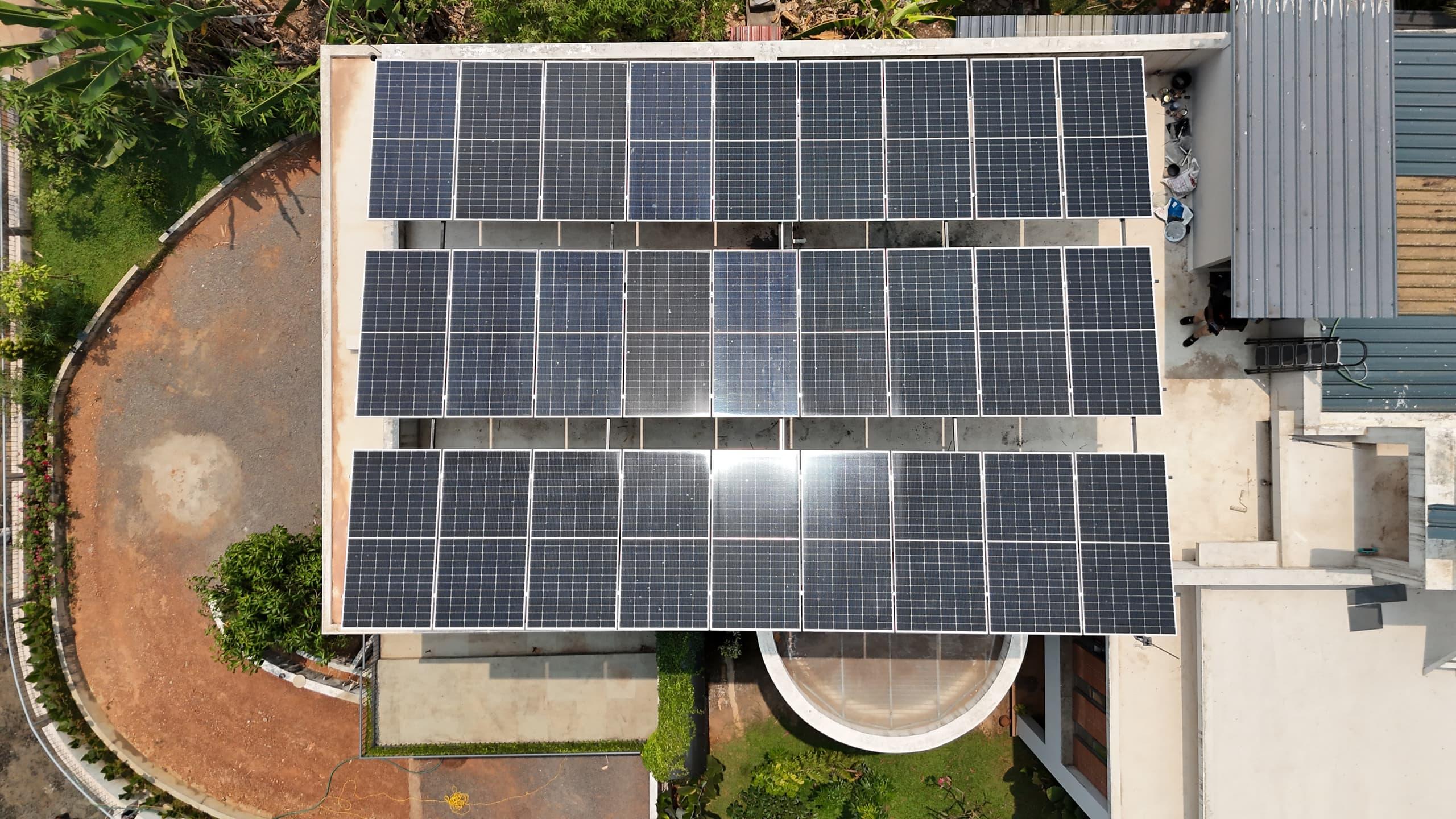


This was the first hybrid installation we filmed, at a house in Ramanattukara in Kozhikode district, and it remains the clearest way to explain what a hybrid system is: an on-grid inverter and an off-grid inverter in one machine, with a battery bank beside it, feeding the house first, the battery second and the grid last. Most of the questions we get about hybrids, whether they export, whether they work during a cut, whether KSEB approves them, are answered by walking round this one site.
The roof: two strings, no shade, cables planned early
Eleven Vikram Solar 535 W modules on a flat roof, mounted about two and a half to three feet up, split into two strings of six and five. The site is unusually good: strong sun, steady wind, and no tree shade at all, which in Kerala is rare enough to mention. Coconut palms are the usual enemy of a clean array, and most of our design work on other roofs goes into placing panels where their shadows will not fall.
Two details that only happen with planning. A lightning arrester is fitted, positioned away from the walkway so it does not obstruct the roof. And every cable is concealed, because we first visited this site six or seven months before installation, while the house was still being built, and the conduits went in with the construction. If you are building, that early conversation costs nothing and saves surface trunking for the life of the house.
The machine: a Deye 5 kW hybrid
The inverter is a 5 kW Deye hybrid. It is transformerless, using high-frequency switching, so it is compact and efficient, and it runs warm enough to carry a small internal fan despite its IP rating. Its display is the most useful part for an owner: a live diagram of what the panels are producing, what the house is drawing, what is going into or out of the battery, and what is flowing to or from KSEB. You do not need to understand inverters to read it.
Two specifications matter for anyone sizing one. The 5 kW machine accepts up to 6 kW of panels, and overloading the DC side a little is worth doing: it fattens the generation curve in the mornings, evenings and monsoon without exceeding the 5 kW AC output. KSEB counts the inverter's capacity as the plant capacity, so 6 kW of panels on a 5 kW inverter is a 5 kW plant for approval purposes. And the machine has a generator input, so a genset can be synchronised as a third source alongside the battery for homes that want it.
One number we measured that we had not seen elsewhere: with the battery in the circuit, the output harmonics stayed under 5 percent. Several brands we have tested run at 12 or 13 percent on battery, which is hard on electronics and pumps. Under 5 is clean power.
Batteries, protection and the changeover
Four Exide 150 Ah solar tubular lead-acid batteries, with a five-year replacement warranty, in a cabinet the customer built himself: the system sits in an open area, so the cabinet guards against theft and against rain coming down from the roof access, with a silicone-sealed top and no child access. The same inverter runs on lithium if the customer upgrades later, and our Ranni record shows that configuration.
Beside the standard DCDB and ACDB that every on-grid system carries, a hybrid adds a battery isolator, a CT coil, and a changeover switch. The CT coil clamps the incoming supply and measures the flow to and from KSEB; it is what allows the zero-export mode described below. The changeover is a simple MCB-type switch: if the inverter ever faults, the owner throws it and the house runs directly from KSEB, bypassing the whole solar circuit until we arrive. No hybrid should be installed without one.
How the load is shared, live
The rule the inverter follows is fixed: panels first, battery second, grid last. On the day we filmed, an air conditioner was running and the house was drawing about 4.4 kW. The display showed the panels supplying the bulk, the battery topping up the difference, and only a small draw from KSEB. When the AC switched off, the load fell, the grid draw stopped, and the surplus began flowing into the battery. All of this happens without the household noticing; there is no changeover click, no flicker.
The battery side can be programmed for charge current, not just voltage. That sounds technical, but it is the difference between a battery bank that lasts its warranty and one that is cooked by an over-eager charger. Few off-grid systems offer it. Hybrids of this class do.
Why hybrid here, and what it costs to be wrong
This customer had three requirements at once: unstable voltage, frequent outages with no reliable backup, and a wish to export surplus like an on-grid home. On-grid alone fails the first two; when the grid drops, or drifts outside its voltage window, an on-grid inverter stops and the roof produces nothing. Off-grid fails the third; once the battery is full on a day the house is empty, generation simply stops. Hybrid satisfies all three, and it is only when all three are present that we recommend paying for one. A home with steady supply and a bill to cut should stay on-grid.
Approval, zero-export, and the twenty days
Hybrids have a practical advantage during the approval period that on-grid systems do not. An on-grid system cannot be switched on before KSEB fits the net meter, because the old meter reads exported energy as consumption and would bill you for your own generation. A hybrid can run in zero-export mode from day one: the CT coil measures what the house is drawing, and the inverter generates exactly that, charges the battery, and sends nothing to the grid. This site ran that way for ten to twenty days, saving its owner the units that would otherwise have been lost while waiting.
And the wait was short. The meter testing division approved the system twenty days after installation, the net meter was collected from the section, and it was fitted within a day or two of filming. An earlier hybrid site of ours had taken six to seven months to get connectivity; approvals for hybrids have become markedly easier, and this was the proof. The system was set to KSEB's required grid and frequency settings before inspection, which is part of why it passed first time.
Your roof, next
Want these numbers for your own house?
A free one-hour roof survey by a SEDNA engineer. Honest size, subsidy filed, quote in writing.
- 4.9 on Google
- 2,500+ installations
- MNRE-approved
- Since 2009