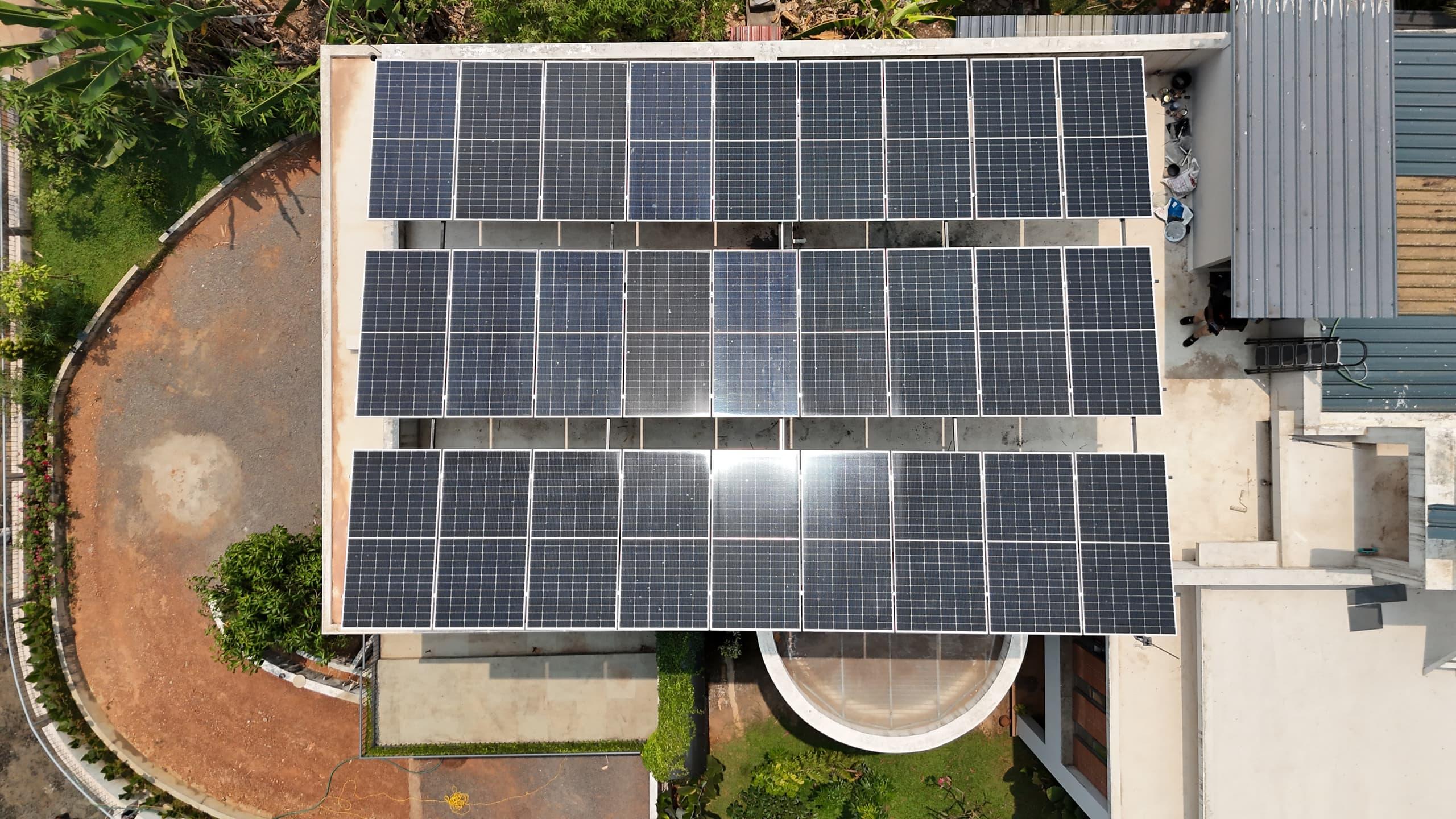


In 2019 this house had a 5 kW system: twenty polycrystalline panels of 250 W each, which was the standard module of the time. It worked, and the owner was happy with it, until his consumption grew and bills started appearing again. He asked us how to get more from the roof without giving up any more of it. The answer, four years on, was to take the old panels off and put a bigger system in exactly the same space, and the site is the clearest demonstration we have of how fast panel technology has moved.
The arithmetic of module wattage
Twenty 250 W panels occupy roughly the area of thirteen modern 545 W panels, and thirteen 545 W panels are 7 kW. So the same footprint that held 5 kW in 2019 now holds 7 kW with a clear working space down the middle, something the 2019 layout never had. The alternative was to keep the old polycrystalline panels and add a second array beside them, and we would have done it if the roof had allowed, but the owner wanted his roof back more than he wanted to keep four-year-old modules.
The panels were put up in two arrays, eight on one side and five on the other, feeding two strings into a new three-phase Deye inverter sized for 10 kW. That leaves room for another 3 kW of panels whenever the load grows again, without touching the inverter. The distribution boxes were replaced too, with ABB switchgear, Finder surge protection and indicator lamps so that the owner can see at a glance if a phase has dropped; a three-phase inverter stops when any one phase is lost, and the indicators tell you which.
The generation, before and after
The old polycrystalline 5 kW gave a daily average of 18 to 20 units. The new 7 kW had recorded up to 36 units a day within its first week, and 311 units in total in that week; on the overcast midday we filmed it had already logged 12. Part of that is simply 40 percent more capacity, but part is the difference between a 2019 polycrystalline cell and a modern mono half-cut cell in Kerala's diffuse light. The neighbourhood tells the same story from the other side: when the 2019 system went in there was no other solar in sight, and by 2024 we counted six installations within about fifty metres.
Paperwork for an upgrade
An upgrade is a new application, not an amendment. The existing feasibility with KSEB was enhanced to the new capacity, the old system was formally dismantled and the new one registered, and the owner applied through the national portal for the current scheme. Whether a replacement like this qualifies for subsidy depends on whether the earlier plant received one; this owner's 2019 system had not, and the application was accepted. If your existing system was subsidised, check the portal's rules before you plan on a second subsidy, and in either case KSEB's feasibility enhancement is a routine request.
The general guide to adding capacity covers the options when you have roof to spare. This site is the other case: when you do not, the newest panels are the way to grow, and a four- or five-year-old array is already old enough for the swap to pay.
Your roof, next
Want these numbers for your own house?
A free one-hour roof survey by a SEDNA engineer. Honest size, subsidy filed, quote in writing.
- 4.9 on Google
- 2,500+ installations
- MNRE-approved
- Since 2009