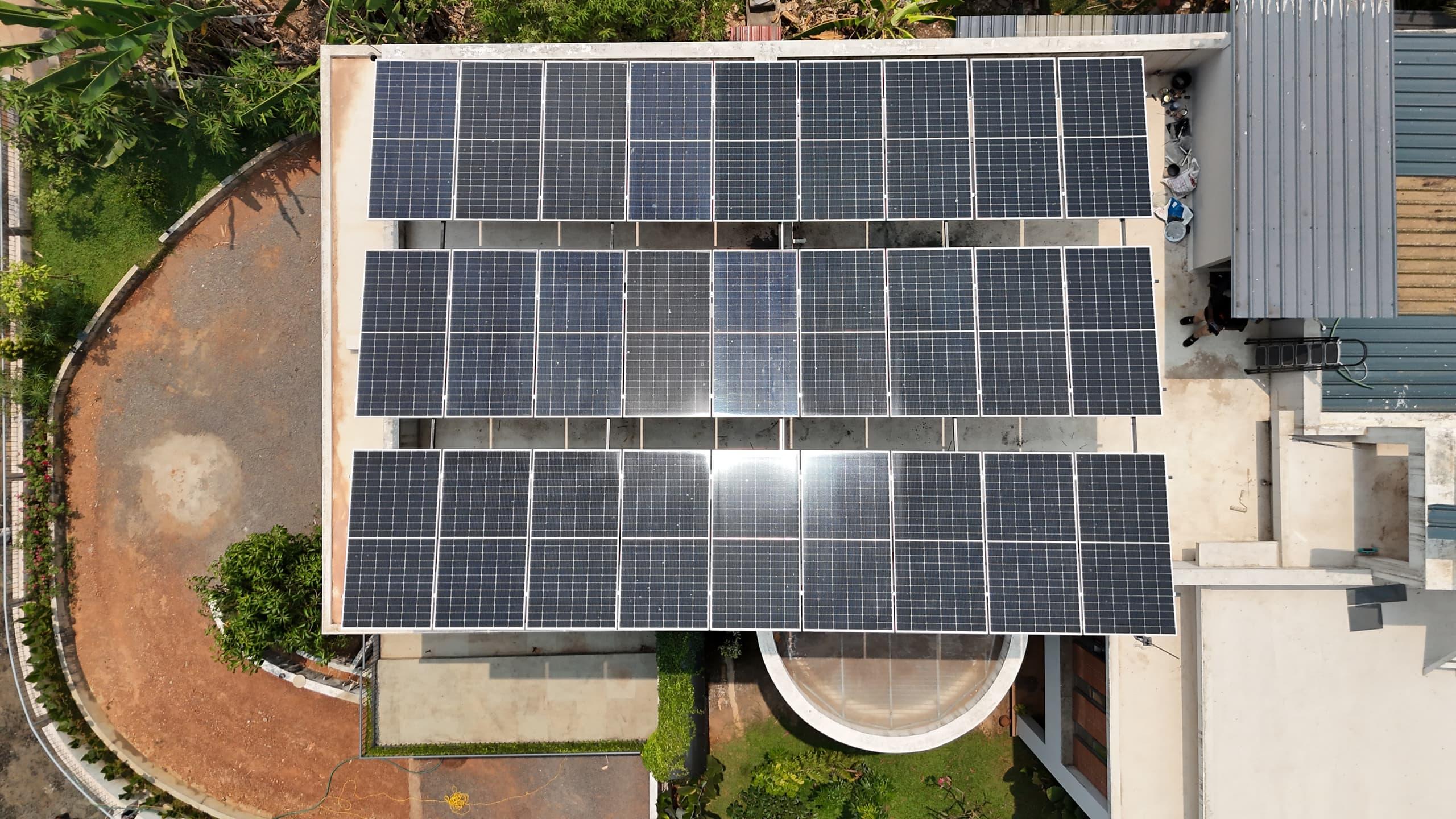


Ranni, in Pathanamthitta, is hill country. Lines come down when trees are cut, storms take the supply off for a day or two at a time, and a home there cannot plan around the grid. The customer, working abroad, had one requirement: a hybrid system with lithium storage, installed and connected before a family wedding. Five months on, we went back, and his father gave us the review that matters: the power cuts they used to live with are simply not felt any more, the air conditioner runs when they want it, and the KSEB reader reports about 20 units a day going out to the grid on top of everything the house uses.
The array and the roof
Nine Adani 535 W modules, 4.8 kW of panels, on a single flat-roof structure: five modules on the upper north row, four on the lower. The height was set for one purpose, to leave a cleaning gap beneath. Two structures would have been the easy choice; one compact structure kept the rest of the flat roof usable, stayed clear of the stair room, and put every module out of the shade line of the trees on the south side. On the afternoon we filmed, cloudy in the morning, the plant had made 14 units by four o'clock and was still producing about 1.5 kW across the two strings.
The battery: Deye SE-G5.1 Pro
The storage is a Deye SE-G5.1 Pro lithium pack: 48 volts, 100 Ah, 5.1 kWh, which in plain terms is five units of electricity held in a rack-mount box the size of a small suitcase. It communicates with the inverter over CAN bus, so the inverter's battery management follows the pack's own limits for charge and discharge current, and five LEDs on the front show state of charge at a glance. The pack lives inside the house, not by the inverter outside, for two reasons: it is the most expensive component on site and should not sit in the open, and unlike lead-acid it produces no fumes and needs no ventilation or topping up.
The Deye inverter can charge and discharge at up to 140 amps, which is why up to four of these packs can be paralleled for about 20 kWh of storage. That headroom is the point: a customer can start with one pack and add backup later without changing the inverter. Several well-known brands cannot do this because their charge current is capped too low.
Lithium against lead-acid, from our own sites: we had completed fifteen to twenty hybrid installations across Kerala before this one, all on Exide solar tubular batteries, which are the best lead-acid option and last about five years. The lithium pack carries a warranty of around ten years, with a working life the manufacturer puts at fifteen to twenty. No water, no terminal cleaning, no maintenance visits. The customer chose it because he was thinking a decade ahead, and was willing to pay for it.
What it cost, at the time
In January 2024, when this system went in, a 5 kW hybrid with a lithium pack of this size came to roughly ₹6.5 to 7 lakh installed. The same system on lead-acid was about ₹5.3 to 5.5 lakh. Lithium prices have been falling and domestic manufacturing is expanding, so treat these as the record of one site rather than a quotation; the difference between the two chemistries is narrowing every year. What has not changed is the arithmetic: lithium costs more once and lasts two to three lead-acid lifetimes.
The rest of the installation
The inverter is mounted outside for natural cooling; it runs warm to the touch under load. Beside it, the usual DCDB and ACDB, an earth pit, the battery cables running indoors, and the CAN cable from the inverter to the battery's management system. A CT coil on the incoming supply measures export and allows zero-export mode if it is ever needed. And an MCB-type changeover lets the household bypass the inverter and run straight from KSEB if the inverter ever faults.
The house is three-phase; the hybrid is single-phase. That is normal and not a limitation. From the distribution board we defined which circuits sit on the inverter's backup output, the lights, fans, fridge, the AC in the main bedroom, and those circuits ride through an outage while the rest of the house behaves as before. During the installation itself the supply failed, so the crew connected the lithium pack to the inverter and ran the drilling from it. Welding had to wait two days for grid and weather; everything else did not.
Monitoring, and why it changes service
A SolarMan WiFi logger reports the system to the cloud. The owner sees generation, consumption, battery and export on a phone. We hold installer access to the same data, which has changed how service works: about 80 percent of what we need to know about a fault is visible before anyone travels. A site 150 kilometres away that shows no AC voltage is a phone call to check the meter and the distribution board, not a day's drive to find a tripped MCB.
Should you choose a hybrid?
The simplest rule we can give, after twenty of these. Choose a hybrid if your outages are frequent and unpredictable, so that on-grid solar would sit idle through hours of daytime sun, or if your supply voltage is unstable, so that an on-grid inverter would keep tripping out of its window. Rural and hill areas often have both. If your cuts are occasional and your voltage is steady, stay on-grid and, if you want backup, add an inverter and battery or a hybrid MPPT beside it, for far less. The right answer depends on your line, not on the technology, and it is the first thing we establish at a survey.
Your roof, next
Want these numbers for your own house?
A free one-hour roof survey by a SEDNA engineer. Honest size, subsidy filed, quote in writing.
- 4.9 on Google
- 2,500+ installations
- MNRE-approved
- Since 2009