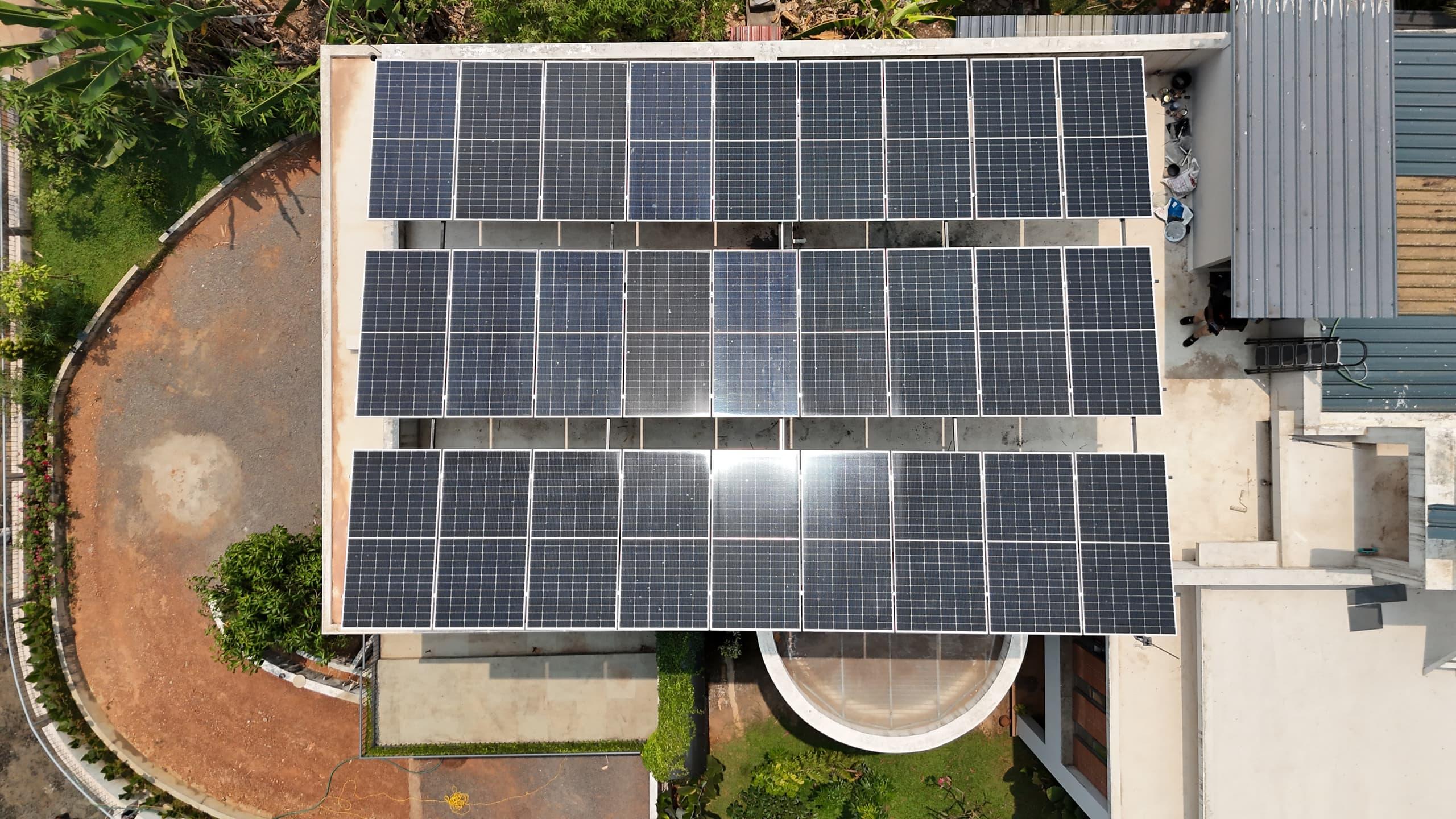


Panels in Kerala clean themselves for about half the year; the monsoon sees to that. It is the dry months, December to April, when dust, pollen and salt haze settle on the glass and take a quiet five to ten percent off generation, and the owner faces a choice between climbing up with a hose every few weeks or paying for a cleaning visit. On a subsidy-scheme installation in Cherthala town, for a retired Air Force officer who wanted neither, we fitted a third option: a row of garden sprinklers along the top edge of the array, fed from the house tap, for a total of roughly ₹1,500 in parts.
The parts, and what they cost
The sprinklers are ordinary garden units sold on Amazon at about ₹299 for a pack of five; the system in the video used nine, so two packs, around ₹600 of sprinkler. Add PVC pipe to run along the top of the array, fittings and a tap or valve at an accessible point, and the total came to about ₹1,500. That is less than a single professional cleaning visit, and it is fitted once.
The sprinklers are mounted along the upper edge so that water sheets down the glass with the tilt of the panels and runs off the bottom edge. Nine heads covered a domestic array with some overlap between the arcs; the number for your roof depends on the array's width and the throw of the sprinkler you buy. Mounting them on the structure rather than the module frames keeps any load off the panels themselves.
What it does well
Dust and dry deposits are what a sprinkler handles: a few minutes of water, early morning, before the glass warms, and the loose layer is gone. Doing that every week or two through the dry season keeps generation close to the clean-panel figure without anyone going up a ladder, which for an older owner or a steep roof is the whole point. It also solves the timing problem. Panel cleaning should happen when the glass is cool; a tap at ground level makes seven in the morning easy.
What it does not do
It does not remove bird droppings, which bake on and shade a cell hard enough to pull down a whole string; those still need a soft brush or cloth. It does not remove salt film near the coast, which needs wiping. And it depends on your water: hard borewell water sprayed on hot glass leaves mineral spots that are worse than the dust it removed. Use it in the cool of the morning and, if your water is hard, treat this as a rinse between proper cleans rather than a replacement for them.
There are automatic systems with brushes and timers that address all of this, and the video that followed this one looks at one; they cost many times more. The sprinkler is the cheap, honest end of the range, and for an unshaded domestic array away from the coast it does most of the job for most of the year.
How to check it is working
The same way you check any cleaning: look at the generation before and after. Note the inverter's daily figure on a clear day before the first rinse, rinse the next clear morning, and compare. A dusty array in March will show the difference clearly. If it does not, the deposit is something water alone will not shift, and it is time for the brush. Our cleaning guide covers the manual method and the mistakes that scratch glass or void warranties; the rule here is the same one: never a pressure jet, never on hot panels, never standing on the modules.
Your roof, next
Want these numbers for your own house?
A free one-hour roof survey by a SEDNA engineer. Honest size, subsidy filed, quote in writing.
- 4.9 on Google
- 2,500+ installations
- MNRE-approved
- Since 2009