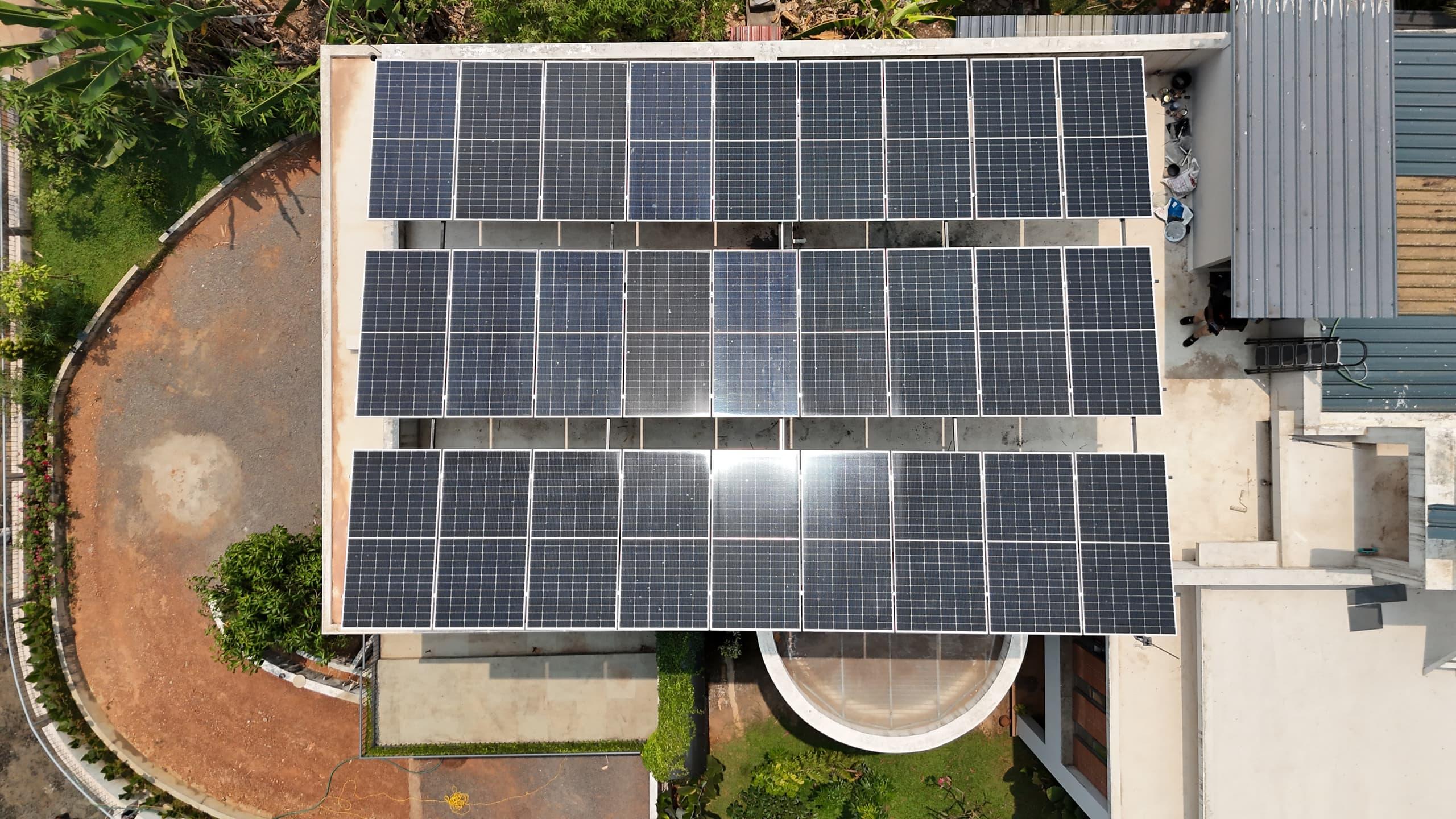


Our most-watched video is fifteen seconds long. It shows an old TATA off-grid solar system, the kind installed in many Kerala homes under earlier ANERT programmes, being given a new SEDNA power conditioning unit. It has been watched more than fifty thousand times. That says something: a lot of people have a system like this, it has stopped doing its job, and few were told it could be fixed.
What wears out, and what does not
An off-grid system has three parts with very different lives. The panels are glass and aluminium with no moving parts; they lose a little output each year but usually keep producing for decades. The batteries are the opposite: tubular lead-acid batteries wear out in a handful of years, faster if they are deeply discharged or not topped up. The power conditioning unit, the box that charges the battery and makes household AC, sits in between; older units use charging methods that waste part of what the panels make, and spare parts for them get harder to find.
So an old system that has gone quiet is usually a good set of panels behind tired batteries and a dated controller. That is a repair, not a replacement.
Option 1: a new PCU and new batteries
The simplest upgrade keeps the panels and the wiring and replaces the electronics and the storage. A modern PCU with MPPT charging gets more out of the same panels, and new batteries, tubular lead-acid or lithium, restore the backup. This is what the video shows. Before quoting it we test the panels' actual output, the cables, the earthing and the structure, because there is no point fitting a new PCU to a string with a failed panel or a rusted frame.
Option 2: convert to on-grid
Many areas that needed off-grid solar fifteen years ago now have a steady KSEB supply. If yours does, converting to on-grid can make more sense than renewing the batteries at all: the surplus goes to KSEB under net metering instead of being thrown away once the battery is full, and there are no batteries to replace again. We have filmed one such conversion, a 1 kW off-grid system rebuilt as 3 kW on-grid. A conversion is a new grid connection, so it goes through KSEB's feasibility and registration like any new system.
Option 3: hybrid, if the power still goes
If KSEB supply has arrived but cuts are still frequent, a hybrid system gives you both: net metering by day and a battery for the essentials through a cut. The existing panels can often be part of it, with more added.
A home inverter can become a solar system too
The same thinking works in reverse. Plenty of homes have a battery inverter for power cuts and no solar at all. Adding panels and a charge controller turns it into a small solar system that charges the battery from the roof instead of from KSEB. We have done this with as little as 450 W of panels.
What to send us
A photo of the inverter or PCU label, a photo of the batteries, and a photo of the panels on the roof. From those we can usually tell you which option fits before anyone visits, and whether your area's supply makes on-grid or hybrid the better long-term answer.
Your roof, next
Want these numbers for your own house?
A free one-hour roof survey by a SEDNA engineer. Honest size, subsidy filed, quote in writing.
- 4.9 on Google
- 2,500+ installations
- MNRE-approved
- Since 2009