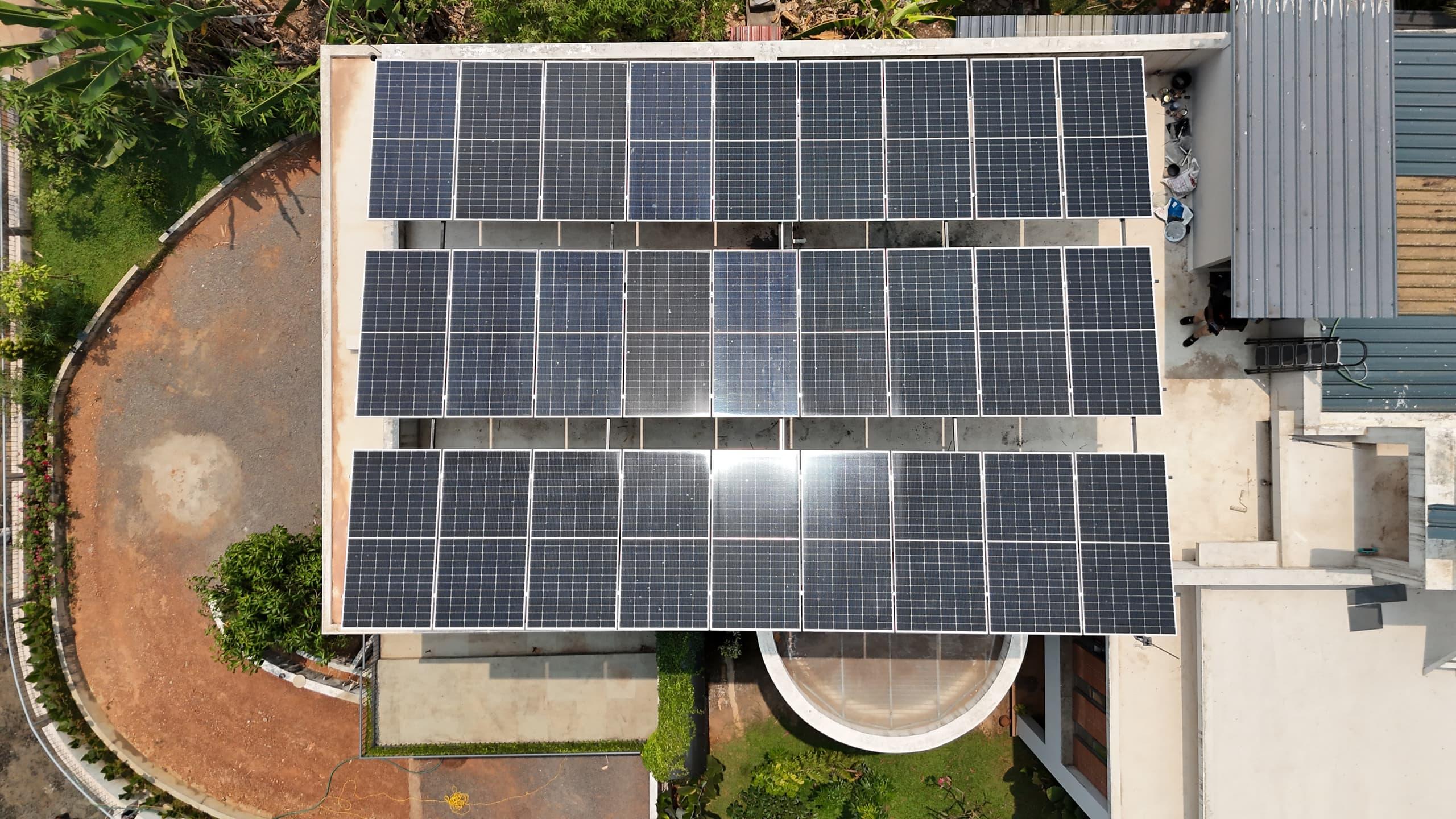


The single biggest complaint from on-grid solar owners in Kerala is that when the current goes, the solar goes with it. The panels are in full sun, the inverter is worth a lakh, and the house is dark. It is not a defect. Every grid-tied inverter is required to stop generating within about 200 milliseconds of losing the KSEB supply, a safety function called anti-islanding, so that no power is pushed into lines where KSEB staff may be working. Mandatory, on every system, no exceptions.
The usual answer is a hybrid system: a different inverter, a battery bank, a changeover. That is the right answer for homes with bad voltage as well as bad supply. But for a home whose only problem is frequent daytime outages, there is a cheaper route that keeps the on-grid inverter you already own and adds a battery beside it. This is what we fitted at a 3 kW site eight months after installing it, and it is worth understanding before you assume you need to start again.
What a hybrid MPPT actually does
A hybrid MPPT is a solar charge controller with one extra trick. In normal operation it sits idle, or works as an ordinary MPPT charger. When it senses the KSEB line has gone, a relay inside it connects the panel DC to its own input, and it charges a battery bank from the roof. When KSEB returns, the relay drops out, the panels go back to the on-grid inverter, and export resumes as if nothing happened.
The device used here is a Cyrus-series hybrid pro MPPT from Asha Power, which accepts the high DC voltage that a string system produces and charges a 24-volt battery bank, lead-acid or lithium. It handles two to four batteries. Its whole job is to make sure the hours of sunshine during an outage are not wasted, and to keep the battery topped up so the existing home inverter can run the essential loads.
How it is wired into an existing on-grid system
Nothing about the original system changes. From the DCDB, the box that carries the panel side, a line is paralleled out through its own MCB to the MPPT's input. From the ACDB, the grid-side box, a sensing line runs to the MPPT so it knows whether KSEB is present. Those two cables are the entire interface. On the battery side, the MPPT feeds the battery bank, and the battery bank feeds the home inverter, exactly as any inverter-battery setup does.
At this site the house already had an old single-battery inverter, so we upgraded it to a Luminous 2,800 VA unit, added a second battery to make a 24-volt bank, and the MPPT charges that bank. The panels are 545-watt Adani modules, the on-grid inverter is a Deye, and both are untouched. With grid present, the MPPT display shows PV voltage and current at zero, grid at 57 hertz-region normal, battery around 26 volts, and the unit sitting in inverter mode. The moment the grid drops, the PV figures come alive.
Why not just go hybrid?
We discussed a full hybrid with this customer first, and decided against it. A hybrid inverter earns its cost in two situations: when supply voltage is unstable as well as unreliable, because a hybrid conditions the output and an on-grid inverter simply refuses to run outside its window; and when you want battery backup, export and generator support all in one machine. This home had none of those. Voltage was steady; the only problem was that the current went off, often, in daytime. For that problem alone, keeping the on-grid inverter and adding a hybrid MPPT and battery costs a good deal less than replacing everything, and the customer reports that outages are no longer a concern.
The same logic applies to the other common half-way solution, an on-grid system paired with an ordinary inverter and battery that charges from the grid. That works, but during a daytime outage the panels contribute nothing; the battery was charged from KSEB the night before. The hybrid MPPT is what lets the roof do the charging while the grid is down.
Who this is for, and who it is not
It suits a home with an on-grid system already installed, steady voltage, and outages that cluster in daylight hours, which in Kerala usually means line maintenance, tree-cutting and storm cuts rather than load shedding. It needs an inverter and battery bank sized to the loads you actually want to keep running: lights, fans, router, fridge. It does not run air conditioning, and it does not help at night, when the roof is dark and the battery is what you charged during the day.
If your outages are long, come at any hour, and you also see the lights dim and flicker, read our hybrid case records from Ramanattukara and Ranni instead; that is a home that needs the full hybrid. If you are choosing between all three for a new install, the on-grid, off-grid or hybrid guide lays out the trade-offs. And if you are not sure which problem you have, that is what the survey is for: bring your last few bills and a note of when the cuts happen, and we can tell you in an hour.
Your roof, next
Want these numbers for your own house?
A free one-hour roof survey by a SEDNA engineer. Honest size, subsidy filed, quote in writing.
- 4.9 on Google
- 2,500+ installations
- MNRE-approved
- Since 2009