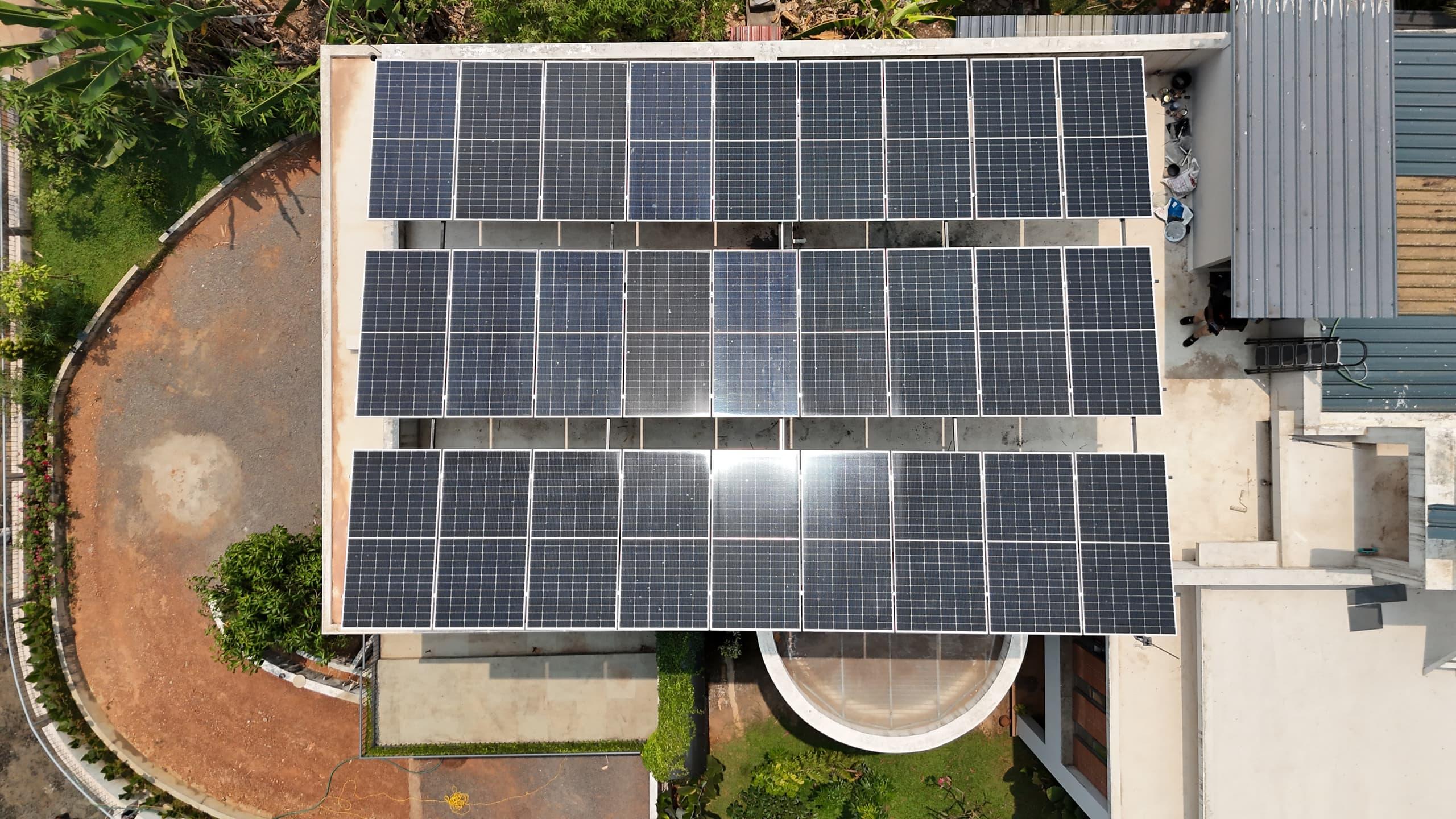


Zero-export is an on-grid system with the export switched off. The inverter still runs from the grid, still synchronises to it, still feeds the house in daylight; it simply never lets power flow out through the meter. Most homes in Kerala do not want this, because net metering is the whole point of on-grid solar. But there are three situations in which zero-export is exactly right, and every hybrid inverter and many on-grid inverters can do it with one small device. This 5 kW installation in the film is set up that way.
How the inverter knows what to hold back
The device is a CT coil, a current transformer clamped around the incoming supply cable at the meter. It measures how much the house is drawing from the grid at every instant and reports it to the inverter. The inverter then generates exactly enough to bring that grid draw to zero and no more: if the house wants 1.8 kW, it makes 1.8 kW; if the sun could give 4 kW, the remaining 2.2 kW is left on the roof. On a hybrid, that surplus charges the battery first and is curtailed only once the battery is full. On a plain on-grid inverter with an export limiter, it is simply not produced.
Set-up is a menu item. On the Deye hybrids we install, the mode is labelled along the lines of zero export to CT, and the export limit can be set to zero or to a permitted figure in watts. The CT must be clamped on the correct cable in the correct direction, which is an installer's job, and once done the inverter's display shows grid import held at or near zero through the day.
Case one: before the net meter arrives
This is the reason most owners meet zero-export. An on-grid system cannot be switched on before KSEB fits the bidirectional meter, because the existing meter reads exported energy as consumption: you would be billed for your own generation. The gap between installation and meter can be a few days in a fast section and a month or more elsewhere, and a finished 5 kW plant loses around 20 units for every day it sits idle.
A hybrid in zero-export mode runs from day one. It powers the house, charges the battery, and sends nothing through the old meter. Our Ramanattukara hybrid record ran this way for ten to twenty days while the net meter was processed. The moment the meter is fitted, the export limit is lifted and the system becomes an ordinary net-metered plant.
Case two: where export is not permitted or not worth it
Some connections cannot export. A commercial premises that has not applied for net metering, a site on a transformer KSEB has flagged as saturated, or a system larger than the sanctioned limit for its category all fall here. Under the KSERC 2025 regulations most domestic homes can net-meter up to 20 kW, so this is rarer for houses than it was, but it still applies to some commercial and institutional roofs.
For a business that consumes almost everything it generates in working hours, zero-export costs very little: the surplus was going to be small anyway. Sizing the system to the daytime load, rather than to the roof, is what makes it pay. The solar for business guide works through that arithmetic.
Case three: a plant bigger than the net-metering approval
Occasionally a customer wants more panels than KSEB will approve for export, for a battery bank, an EV, or future load. A hybrid can be configured so that export is limited to the approved figure while the array behind it is larger; the excess charges storage or is curtailed. KSEB counts the inverter's AC capacity as the plant capacity, so the arrangement has to be declared honestly at application; it is the export limit that is being set, not the system hidden. Done properly it is an approved and increasingly common configuration.
What zero-export is not
It is not a way to avoid KSEB approval. A grid-connected system, exporting or not, must be inspected and commissioned; the anti-islanding, earthing and protection requirements apply regardless, and an unapproved connection is both unsafe and uninsurable. It is also not off-grid: the inverter still needs the grid present to run, and in a power cut a zero-export on-grid system goes dark like any other unless it is a hybrid with a battery.
If your reason for asking about zero-export is that you have heard net metering is being reduced, read the 2026 rules first. Domestic net metering in Kerala survived the draft that would have capped it at 3 kW; the notified regulations allow up to 20 kW. For most homes, exporting is still the right design, and zero-export is the bridge you use until the meter arrives.
Your roof, next
Want these numbers for your own house?
A free one-hour roof survey by a SEDNA engineer. Honest size, subsidy filed, quote in writing.
- 4.9 on Google
- 2,500+ installations
- MNRE-approved
- Since 2009