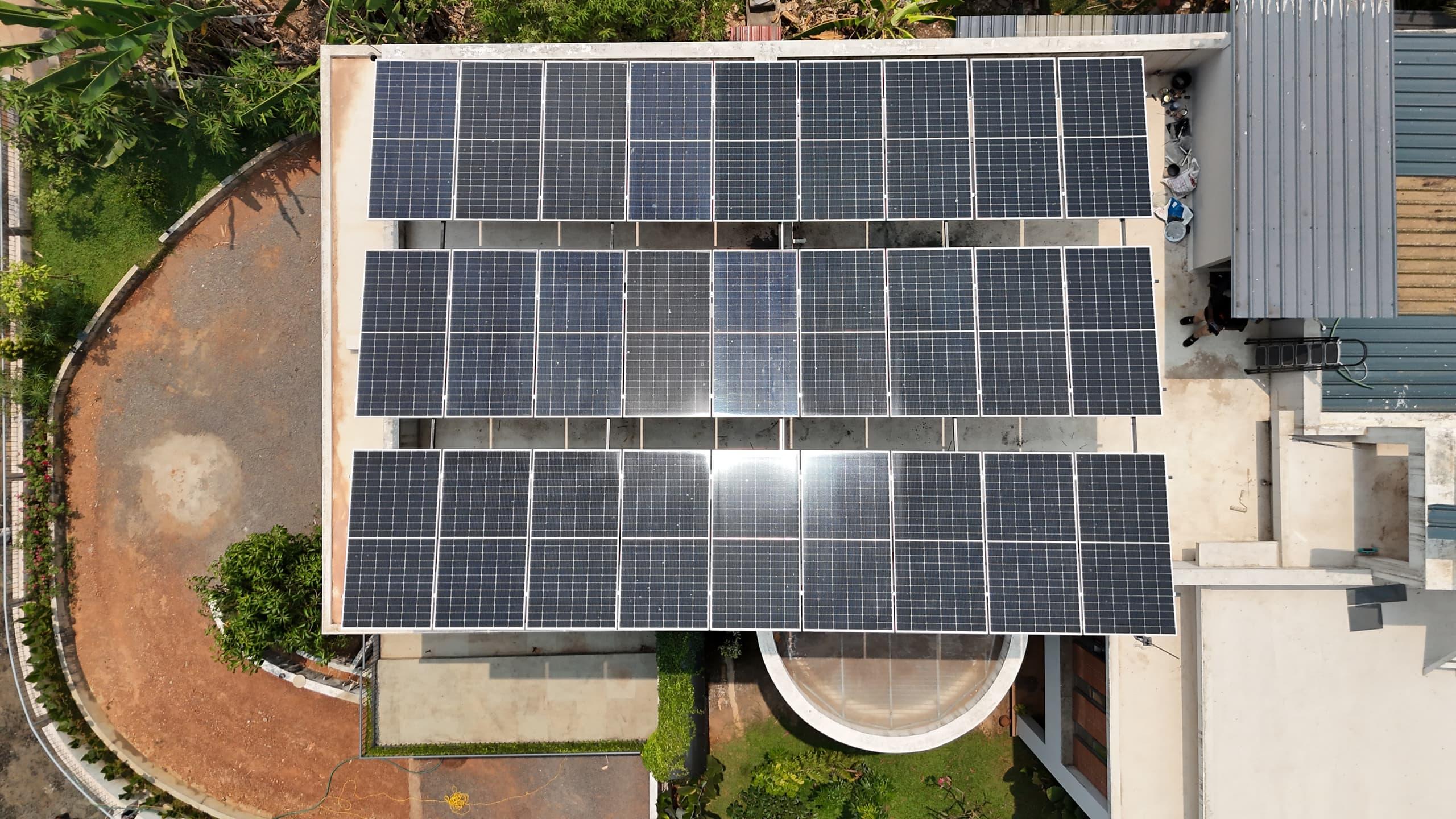


The most talked-about panel in the market this year is the N-type TOPCon module, and this 3 kW installation at Poochakkal in Alappuzha district is a good place to see what the talk is about. Six Adani 565 W N-type modules on a two-metre elevated structure, a Deye inverter chosen specifically for them, and a measured average of 17 to 18 units a day. That is a strong figure for 3 kW in Kerala, and the reasons for it are worth going through one at a time, because two of them have nothing to do with the panel.
What N-type actually changes
Conventional modules use P-type silicon. N-type TOPCon uses the opposite doping, and the practical results are two. Output is one to two percent higher for the same rated wattage, and low-light performance is better: early morning, late afternoon and overcast skies, which in Kerala is a great deal of the year. Every major manufacturer is moving to N-type; it is where the industry is going rather than a niche.
The detail that matters for subsidy: Adani was the first to launch N-type modules under DCR, domestic content requirement, meaning cells and modules made in India. That is the condition for the PM Surya Ghar central subsidy, and this project was completed under the scheme. An imported N-type panel might be an excellent panel and still disqualify your claim; the DCR guide explains how to check.
The inverter these panels demand
N-type modules run at lower voltage and higher current than the P-type modules most inverters were designed around: 15 to 16 amps at peak on these, and the 600 W-class modules now arriving push 17 to 18 amps. Many string inverters on the market accept a maximum of 15 amps per input, and an inverter that clips the current wastes exactly the extra output you paid for.
So the inverter here is a 3 kW Deye, rated for 20 amps of DC input. We install a great deal of Growatt and Sofar, and their higher-current models are coming, but for these modules today the Deye was the right match. It is a good example of a rule we keep repeating: the panel and the inverter are a pair, and a quote that lists a premium module with an inverter that cannot take its current is a quote for a system that will underperform.
The structure: two metres up, painted white beneath
The original plan was a low structure, about four feet, on one of the house's two flat roof areas. The customer had read about bifacial gain, the extra output from light reflected onto the back of the module, and asked for a raised installation. So the array stands on an elevated structure with the south legs at two metres and the rear at about 2.6, on posts anchored through base plates into the slab, with a side tie into the parapet for stiffness. The roof under it was later painted white to increase reflection.
Here is the honest engineering: a bifacial module at a normal four-foot height gains almost nothing, because there is not enough light reaching the rear face. In our experience across several sites, the rear-side gain only becomes real above about one and a half metres of clearance, and it improves further with a light-coloured surface beneath. This site has both, and the 17 to 18 units a day is partly that. A 40 cm gap is left in the array for cleaning access, and the structure uses smaller-gauge pipes braced for leverage rather than heavier sections, so the roof area below stays usable.
Placing the array where the meter is
The house has flat roof areas on both the north and south sides. The array went on the north, not for sun but for cable length: the KSEB meter is on the north side. DC losses grow with the length of the run from panels to inverter, and the shortest DC link is the most efficient system. Choosing the roof nearer the meter cost nothing in generation on this site and saved a long high-current DC cable. The AC side is protected by a 32-amp AC distribution board, and the DC side by a DCDB specified for the higher current of these modules.
Four days to connection, and why that matters
The KSEB Poochakkal section deserves a mention: after we submitted completion, the connectivity was done in four days. That is exceptional. In many sections the wait is up to a month, and every day a finished 3 kW plant waits for its net meter is about 15 units lost, because an on-grid system cannot run before the meter is fitted. Some sections have started to move faster as more systems come through, and this one is a model for it.
At eleven in the morning on the day we filmed, the array was delivering about 2,700 watts live from 3 kW of modules, which is what a well-placed N-type array on a clear day should do. If you are planning a system this year, N-type is the sensible default; just make sure the inverter beside it on the quotation can take the current.
Your roof, next
Want these numbers for your own house?
A free one-hour roof survey by a SEDNA engineer. Honest size, subsidy filed, quote in writing.
- 4.9 on Google
- 2,500+ installations
- MNRE-approved
- Since 2009