

Our videos are usually shot in front of a house or a flat. This one was shot at a toddy shop in Kavalam, in the heart of Kuttanad, which you reach by parking on the road and taking the shop's boat for five minutes across the water. It is a popular stop for tourists and for people who come for the food, guests eat on moored houseboats, and the kitchen runs on electricity: cooking, air conditioning for the guests, and freezers full of stock. The electricity bill was, in the owner's word, frightening, and he asked what could be done.
The site
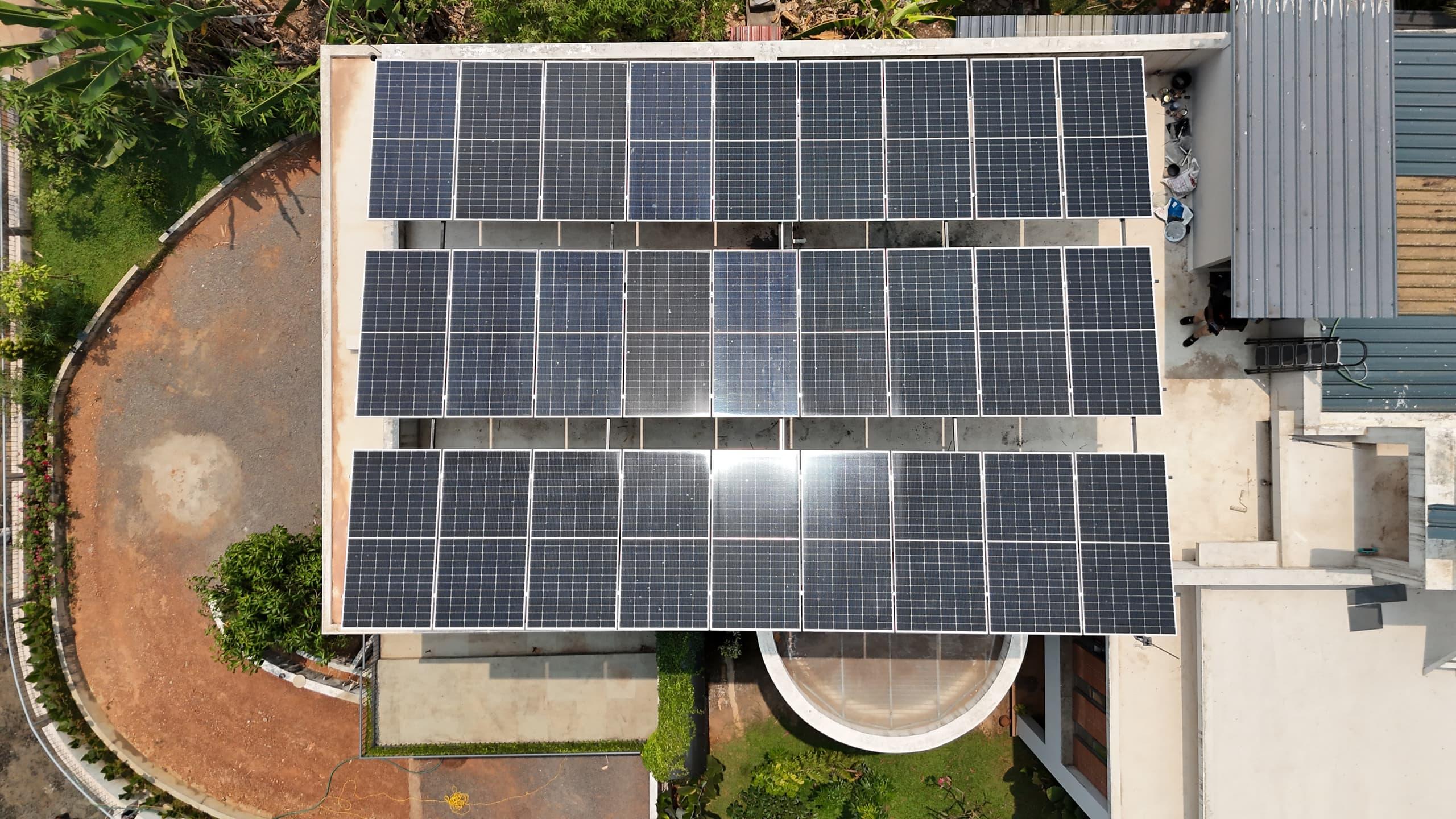
The shop occupies a very small strip of land between the backwater and a paddy field. There is no roof worth mounting on. What there is, beside the shop, is an open patch with clear sky from sunrise to sunset. We concreted legs into the paddy-side ground, built an elevated structure over it, and mounted the array on that. Because the ground floods and cables must never lie in water, the cable run from the array to the shop is hung on a tensioned support, in the air, all the way to the distribution board inside the building where the inverter lives.
The panels are 620 W TOPCon modules making up about 8 kW, and this was the first fully open-ground array we had built. The generation taught us something about shade that no rooftop had: with unbroken sun from first light to last, the plant has been recording 45 to 48 units a day from 8 kW, at the top of what the size can do.
On-grid, by choice
There are power failures here; it is Kuttanad. The owner still chose on-grid rather than hybrid, and it was the right call for a business with a budget. A hybrid with a battery bank large enough to run freezers and air conditioning through outages would have doubled the investment; the shop's problem was the size of the bill, and an on-grid plant under net metering addresses that directly at the lowest cost per kilowatt. If outages grow to the point of spoiling stock, the inverter can be paired with storage later, but the money went where the problem was.
Size for the business you will have
The other decision was capacity. A commercial load grows: another freezer, another air-conditioned room, a bigger kitchen. We sized the plant with the next one or two years in mind rather than last month's bill, and left the structure and the inverter with room to add panels. For a business, the question to answer before signing is not what the bill is now but what it will be when the expansion you are already planning is running.
Anywhere the sun falls
We have installed on flats, villas, a cinema and now a toddy shop reached by boat. The common thread is not the building; it is unobstructed sky and a bill worth cutting. One caution for anyone in a rural pocket like this one: transformers across Kerala are filling up with solar connections, and KSEB's feasibility portal shows the loading on yours. Check it before you plan, and if there is headroom, do not wait for it to close.
Your roof, next
Want these numbers for your own house?
A free one-hour roof survey by a SEDNA engineer. Honest size, subsidy filed, quote in writing.
- 4.9 on Google
- 2,500+ installations
- MNRE-approved
- Since 2009