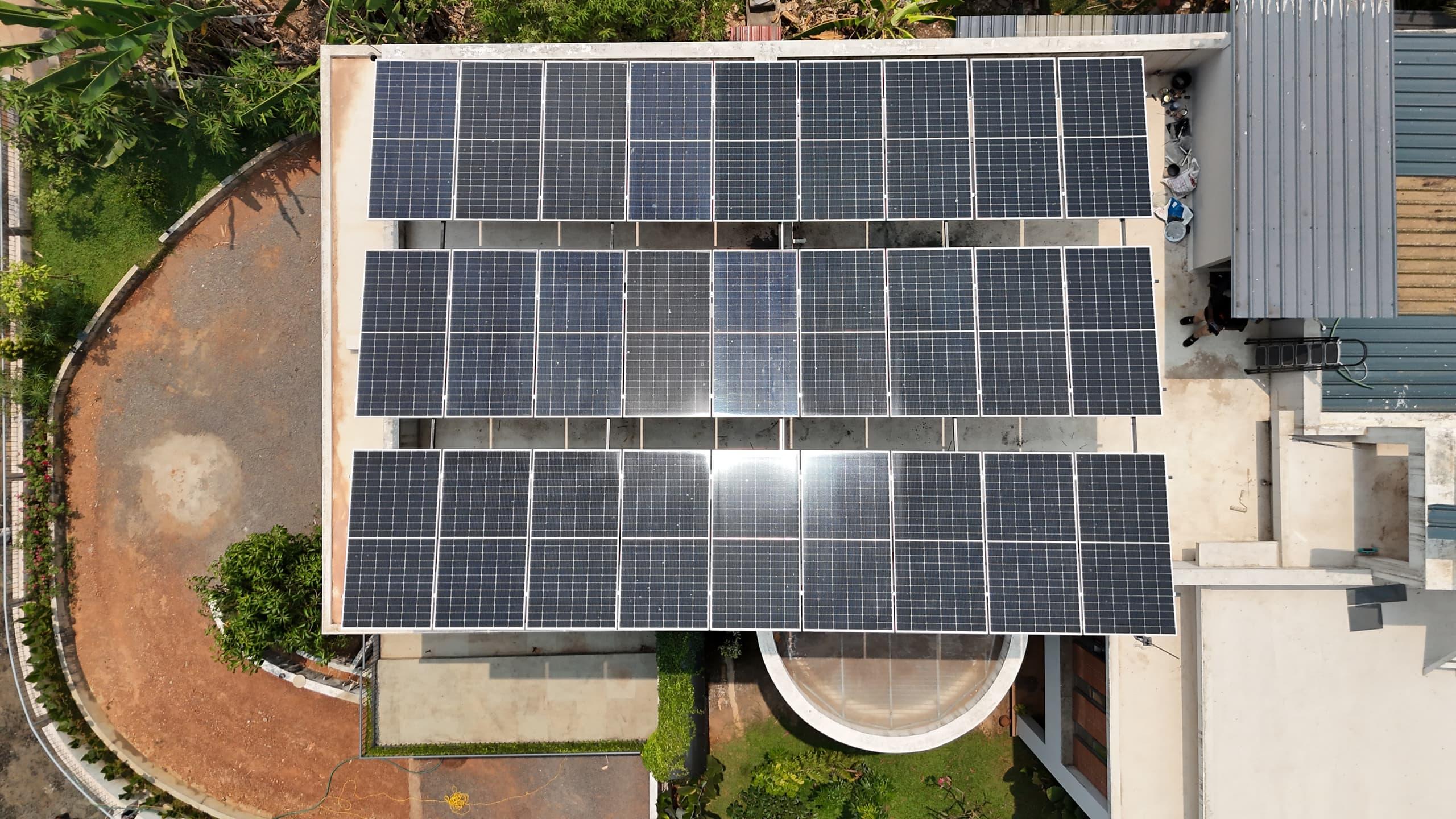


The first KSEB bill after solar confuses almost everyone, because it is a different document. It arrives every month instead of every two, it has a new section headed solar details, and it carries three separate sets of readings where there used to be one. Once you know what each line is, the bill becomes the best free monitoring tool you have. Here is a real one, from a 10 kW on-grid system on a domestic connection, read from top to bottom.
The header: cycle, tariff and sanctioned load
Name, address, phone, post number and the transformer you are fed from are as before. Two things change. The billing cycle becomes monthly, a 30-day validity, so the previous and current reading dates are a month apart. And the tariff line reads LT-1A, the domestic tariff every home connection runs on.
Connected load is shown too, and under the current rules it matters for how much solar you can install. This home has a 20 kVA three-phase connection, which is why KSEB approved a 10 kW plant and would approve up to 20 kW, subject to the local transformer having capacity. That ceiling for domestic net metering comes from the KSERC 2025 regulations; the bill is simply showing you where you sit against it.
Solar details: model, capacity and the banking line
This new block lists the inverter model installed and the plant capacity in kW. Then comes the line people ask about most: current banking units. This is the running total of units you have exported to KSEB beyond what you have drawn back, the credit KSEB is holding for you. Think of it as a barter account. Daytime surplus goes in, night-time and cloudy-day consumption comes out, and whatever is left carries forward to the next month. Older bills never showed this figure; you had to work it out. Now it is printed.
Main meter: import and export from the net meter
The block marked MM, main meter, is your net meter, the bidirectional KSEB meter. It gives two pairs of readings. kWh I is import: the cumulative units you have taken from KSEB. Current reading minus previous reading is this month's import. On this bill that is 431 units, the total drawn from the grid over the month, mostly at night.
kWh E is export: the cumulative units sent to KSEB. Same subtraction, 520 units this month. That is the surplus that left the house during daylight after the house had taken what it needed. Import and export are recorded separately because they are settled separately; the net between them is what moves the banking line.
Generation meter: what the roof actually made
Every solar consumer has a second meter, a tested generation meter fitted by the installer, and KSEB reads it too. Its reading appears under the T1 time zone, 6 am to 6 pm, because that is the only zone in which a solar plant produces. This reading should match your inverter's own monthly total almost exactly; if it does not, one of them needs checking.
On this bill, current minus previous gives 634 units generated in the month. Now compare that with the 520 exported. The difference, 114 units, is what the house consumed directly during the day while the sun was up: the fridge, the fans, the pump, the working-from-home laptop. Those units never touched KSEB in either direction. This is the number that tells you how much of your generation you are using live, and it is why a home that runs its heavy loads in daylight, the washing machine, the water heater, the EV charger, sees a smaller bill than one that runs everything at night.
Averages, fixed charges and meter rent
The bill prints averages beside each block, your typical monthly consumption and export, which are useful for spotting a bad month. Then the charges. There is a fixed charge, which depends on your connection category and load and is worth its own explanation, so we will not pretend to derive it from one bill. And there is meter rent: ₹35 on this bill, because this net meter is rented from KSEB rather than purchased outright. The total due on a month with 431 units imported against 520 exported and a healthy bank came to ₹345, almost all of it fixed charges and rent.
The three numbers to write down every month
Generation from the T1 line: is it what your plant size should give? A 10 kW system in Kerala should be somewhere around 1,000 to 1,200 units in a good month and lower in the monsoon. Export from kWh E: is it a sensible fraction of generation? If export equals generation, nothing in the house ran in daylight, which is unusual. Banking: is it growing through the bright months and falling through the wet ones? That is the shape of a system doing its job.
If generation drops without the weather explaining it, start with the five-minute working check and the panels themselves. If the readings on the bill do not match your inverter app, keep both records and raise it with the section office; the bill is the document KSEB settles on, so the time to query a reading is the month it happens, not at the annual settlement.
Your roof, next
Want these numbers for your own house?
A free one-hour roof survey by a SEDNA engineer. Honest size, subsidy filed, quote in writing.
- 4.9 on Google
- 2,500+ installations
- MNRE-approved
- Since 2009