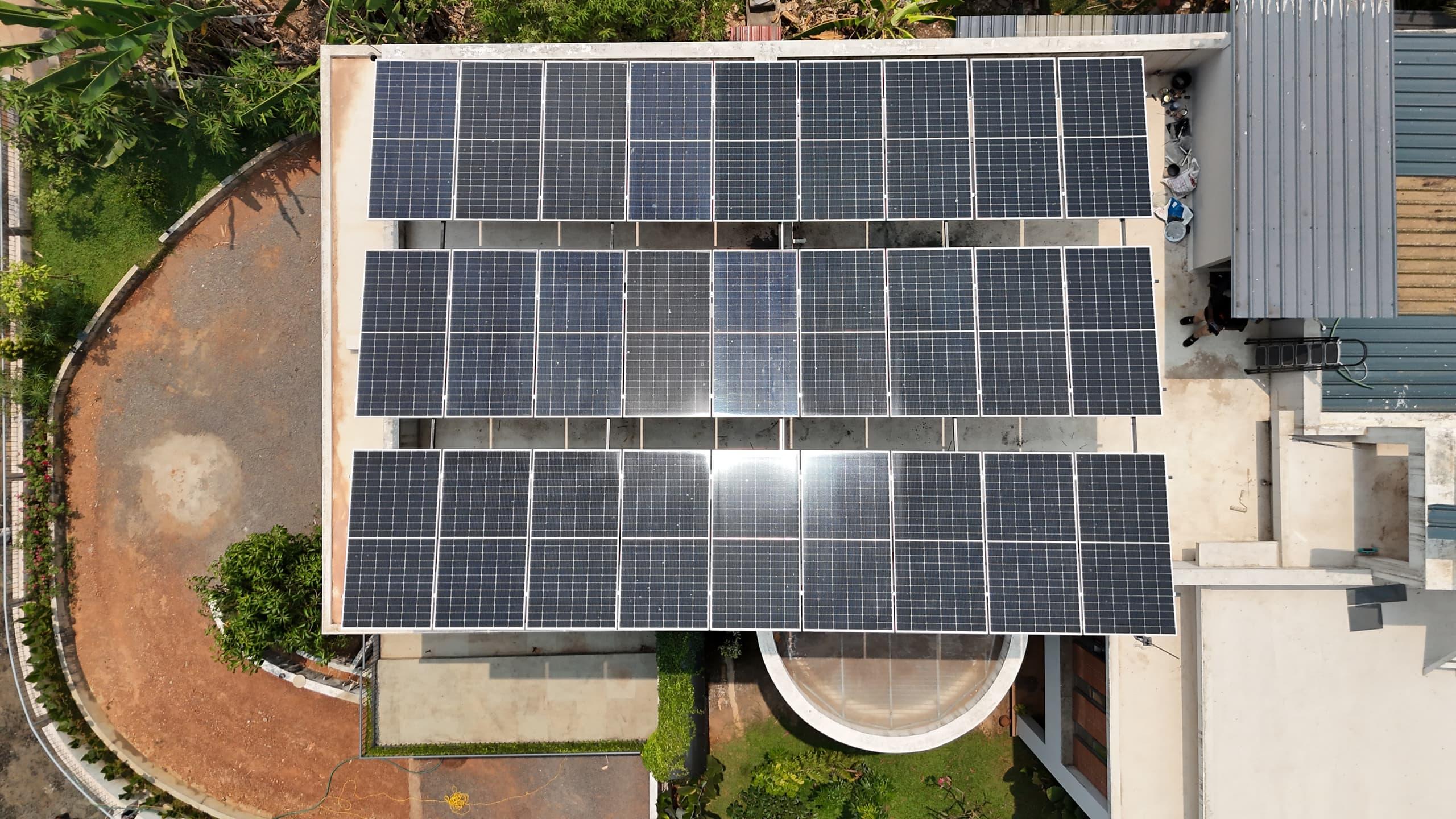


Every solar conversation in Kerala eventually arrives at one question: what happens during a power cut? The three system types answer it differently, and the right choice depends on your locality's supply, not on which system a salesman has in stock.
On-grid: the economics champion
No batteries, highest efficiency, lowest cost per kW, and excess power sold to KSEB. The trade-off is honest and unavoidable: when the grid fails, the system switches off for lineman safety. If outages in your area are rare and short, this is almost always the right choice, and it is what the ₹78,000 subsidy is designed around.
Off-grid: independence at a price
Everything runs from batteries, so power cuts simply do not reach you. But batteries are the most expensive and shortest-lived part of any solar system, needing replacement every 5 to 6 years, and charge-discharge losses reduce overall efficiency. Off-grid earns its cost in places where the grid is genuinely unreliable or unavailable.
Hybrid: the middle path
A hybrid system exports to the grid like on-grid, but keeps a battery for essential loads during outages. You choose which circuits stay alive: lights, fans, the fridge, the Wi-Fi router. It costs more than on-grid and less than full off-grid autonomy, and for households that lose power a few evenings a month, it is often the honest sweet spot.
Our survey includes the question that decides this: how often, and for how long, does your specific area actually lose supply? Answer that honestly and the system type chooses itself.
The cost picture, honestly
Take a 3 kW home as the yardstick. On-grid: the baseline cost, minus the full ₹78,000 subsidy. Hybrid: add a battery sized for essentials, commonly ₹40,000 to ₹1 lakh depending on capacity and chemistry, plus a hybrid inverter premium. Off-grid: the largest battery bank of the three and no grid safety net, which forces conservative oversizing of both array and storage. Batteries also recur: quality lithium roughly every 8 to 10 years, lead-acid roughly every 5. The grid connection you already pay KSEB for is, viewed coldly, the cheapest backup battery on the market.
Sizing a hybrid battery like an engineer
List the loads that must survive an outage: lights, fans, phone charging and the router usually total under 500 watts. A refrigerator adds intermittent load. Multiply by the hours you actually lose power, add margin, and you land on the honest battery size, which for most Kerala homes is 2 to 5 kWh, not the whole-home monsters that double a quote. Backup for what matters beats backup for everything.
Three households, three right answers
A Cherthala family on a stable feeder with a ₹3,500 bill and brief outages a few times a month: on-grid, full subsidy, shortest payback. A Kuttanad home where monsoon outages run hours at a time: hybrid, essentials-sized lithium, exports on good days. A farmhouse beyond reliable supply: off-grid, generously sized, with the discipline about consumption that off-grid living demands. Same state, same sun, three different correct systems, which is the entire argument against one-size quotes.
Your roof, next
Want these numbers for your own house?
A free one-hour roof survey by a SEDNA engineer. Honest size, subsidy filed, quote in writing.
- 4.9 on Google
- 2,500+ installations
- MNRE-approved
- Since 2009