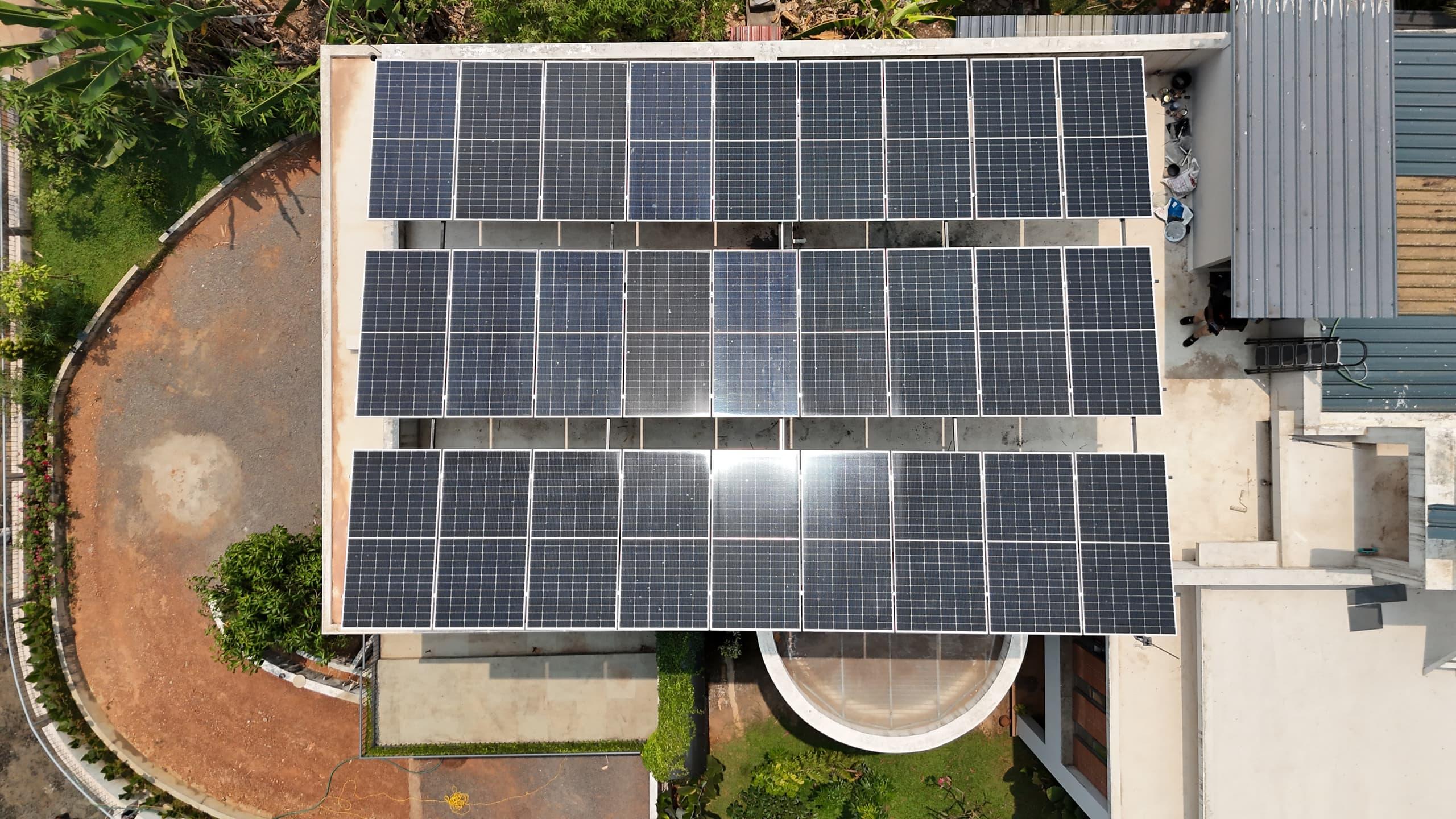


This is the call we get every April and May. A customer who has paid nothing but fixed charges for months opens a bill with an energy charge on it. The panels are fine, the inverter is fine. What has happened is the annual settlement of banked energy, and once you know how KSEB's banking works the bill makes sense. It also tells you how to avoid the surprise next year.
How banking works
Suppose your plant generates 500 units in a month and your house uses 400. Under net metering the extra 100 units are not paid out; they are banked, carried forward as a credit into the next billing period. If you again use less than you generate, the credit grows. If one month you use more than you generate, the shortfall is drawn from the bank first, and only when the bank is empty do you pay for imported units.
The bank has a life. KSEB's settlement period runs with the financial year, so whatever credit remains on March 31 is settled: the unused units are paid for at a rate set by the regulator, which is a fraction of the retail tariff, and the balance resets to zero on April 1. In effect the banked units are worth one for one during the year and very little at the end of it.
Why April is the month it bites
April begins with an empty bank and is also the month Kerala uses the most electricity: air conditioners, fans, pumps, all day. Through the winter your surplus quietly built up and covered evening use without you noticing. In April there is no cushion, so any month in which consumption exceeds generation shows up immediately as an energy charge. Owners who kept the same habits as in February are the ones who get the surprise.
There is a smaller detail worth knowing. When you import more than you export in a period, the excess units are billed at the slab rate for that quantity. A hundred excess units land in the lowest slab, at a low per-unit rate, so a modest overrun in April is not expensive. It is the sudden appearance of a charge, not its size, that alarms people.
Where to see your banked units
The bill KSEB emails you shows it. On the second page there is a banking section that lists the credit carried forward, what was drawn this period and what remains. Read it every cycle. If it shows the bank being drawn down month after month, you are consuming more than the plant makes and the April bill is predictable; if it is growing, you have headroom for an EV or another air conditioner. The article on reading your KSEB bill after solar walks through the whole sheet.
The misunderstanding underneath
Behind most April calls is one assumption: that solar means unlimited electricity. It does not. A 3 kW plant in Kerala makes about 360 units a month across the year, more in the dry months, less in July. If a household uses 600 units, a 3 kW plant was never going to zero the bill, and a bill that arrives in April is not a fault; it is arithmetic. Knowing your plant's real monthly output, from the generation meter reading on each bill, is the only way to judge whether a bill is right.
Two practical habits help. Use your heaviest loads in daylight, when the roof is producing and the house draws from the panels before anything is exported. And if you find the bank is being emptied every year in the dry months, that is a sizing signal: the plant is a kilowatt or two small for the house it serves, and most inverters installed in the last few years have room for a few more panels.
Your roof, next
Want these numbers for your own house?
A free one-hour roof survey by a SEDNA engineer. Honest size, subsidy filed, quote in writing.
- 4.9 on Google
- 2,500+ installations
- MNRE-approved
- Since 2009